USS Ted Stevens (DDG 128): Flight III Arleigh Burke-Class Destroyer Completes Sea Trials
-
| Defense Systems Analyst

The U.S. Navy’s latest Arleigh Burke-class destroyer, USS Ted Stevens (DDG 128), has successfully completed sea trials off the coast of Maine. As a Flight III variant built by General Dynamics Bath Iron Works (BIW), DDG 128 represents a significant technological leap in naval air and missile defense capabilities through integration of the AN/SPY-6(V)1 radar and Aegis Baseline 10 combat system.
Flight III Evolution: From Legacy to Next-Gen Air Defense
USS Ted Stevens is part of the third and most advanced iteration of the Arleigh Burke-class destroyers—Flight III—designed to replace aging Ticonderoga-class cruisers in key air and missile defense roles. The primary enhancement is the Raytheon-built AN/SPY-6(V)1 Air and Missile Defense Radar (AMDR), which offers significantly improved sensitivity and discrimination over the legacy SPY-1D(V).
Compared to earlier variants:
- Flight I/II: Equipped with SPY-1D radar; limited ballistic missile defense capability.
- Flight IIA: Added helicopter hangars; incremental improvements in sensors and C4I.
- Flight III: Incorporates AMDR + Aegis Baseline 10; enhanced power/cooling systems to support high-power sensors.
The SPY-6 radar provides up to 30 times greater sensitivity than its predecessor and allows simultaneous tracking of ballistic missiles, cruise missiles, aircraft, and surface targets. This makes DDG 128 a cornerstone for future Integrated Air and Missile Defense (IAMD) within carrier strike groups or as an independent node in distributed maritime operations.
Sea Trials Validate Hull-Machinery-Sensor Integration
The recently completed builder’s trials—conducted by BIW with Navy oversight—tested propulsion systems, auxiliary machinery, electrical generation/distribution networks, damage control systems, navigation equipment, communications suites, and integrated combat systems. These trials are critical precursors to acceptance trials led by the Navy’s Board of Inspection and Survey (INSURV).
According to BIW statements corroborated by NAVSEA sources:
- Main propulsion plant operated within design parameters throughout sustained speed runs.
- C4ISR systems demonstrated successful data fusion across multiple sensor inputs during simulated threat engagements.
- No major deficiencies were reported that would delay transition to acceptance testing phase.
The ship will now undergo final outfitting before formal delivery later this year. Once commissioned into active service—tentatively scheduled for early-to-mid 2026—USS Ted Stevens will join other Flight III ships like USS Jack H. Lucas (DDG 125), which was commissioned in October 2023.
Aegis Baseline 10 & Combat Systems Integration
A critical enabler for Flight III performance is the Aegis Combat System Baseline 10 developed by Lockheed Martin. This software-hardware suite integrates SPY-6 with Cooperative Engagement Capability (CEC), Standard Missile family interceptors—including SM-2 Block IIIC/SM-6—and future hypersonic defense interceptors under development.
Key features include:
- Multi-domain tracking: Real-time fusion of radar + EO/IR + offboard sensor data via Link-16/CEC networks.
- BMD capability: Enhanced discrimination against complex ballistic threats including maneuvering reentry vehicles (MaRVs).
- Cyber-hardened architecture: Designed for contested electromagnetic environments with improved resiliency against cyber/EW threats.
This level of integration transforms DDG 128 into a floating sensor-fusion node capable of cueing other shooters or engaging threats autonomously under distributed kill chain doctrine—a key tenet of U.S. Navy Distributed Maritime Operations (DMO).
Bursting at the Hull: Power & Cooling Upgrades
The addition of SPY-6 required significant redesigns below deck compared to earlier Burkes. The AMDR consumes substantially more power (~3x increase) than SPY-1D(V), necessitating new Rolls-Royce MT30 gas turbine generators delivering ~12 MW each—up from ~7 MW on prior flights—and upgraded electrical distribution architecture based on zonal power nodes.
Cooling demands were also addressed via enhanced chilled water plants and HVAC upgrades throughout mission-critical compartments. These changes increase displacement slightly (~9,700 tons full load vs ~9,200 tons on Flight IIA) but preserve hull form commonality for lifecycle maintenance efficiency across classes.
Naming & Legacy: Honoring Senator Ted Stevens
The ship is named after former U.S. Senator Ted Stevens from Alaska—a World War II pilot who served over four decades in Congress championing defense appropriations. His legacy includes pivotal support for naval modernization programs during Cold War drawdowns and post-Cold War restructuring efforts that preserved surface fleet investment continuity into the early Arleigh Burke era.
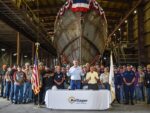
This naming continues a tradition within the class where ships honor influential political leaders alongside military heroes—e.g., USS Daniel Inouye (DDG 118), USS John Basilone (DDG 122). The christening ceremony was held on August 19th, 2023 at BIW shipyard with members of Stevens’ family in attendance as sponsors.
The Road Ahead: Production Tempo & Strategic Role
Bath Iron Works currently has multiple Flight III hulls under construction including DDGs 130–133. Ingalls Shipbuilding is also producing parallel units under multi-year procurement contracts authorized through FY2025 NDAA funding lines totaling over $5 billion USD across both yards combined.
The Navy plans to continue building Flight IIIs into at least FY2030 as it transitions toward its next-generation Large Surface Combatant program (“DDGX”), which remains in early design stages as of mid–2024. Until then, ships like USS Ted Stevens will serve as linchpins for layered maritime air defense against evolving peer threats such as Chinese DF-series anti-ship ballistic missiles or Russian Kalibr cruise missile salvos launched from standoff ranges.