U.S. and Saudi Arabia Conduct Largest-Ever Counter-Drone Exercise in Middle East
-
| Cyber & Electronic Warfare Specialist

In a significant escalation of regional counter-unmanned aerial systems (C-UAS) cooperation, U.S. and Saudi Arabian forces recently completed the third iteration of Exercise Red Sands—now recognized as the largest counter-drone military exercise ever held in the Middle East. The event reflects growing urgency among Gulf states to neutralize evolving drone threats from state and non-state actors.
Red Sands 2025: Scope and Strategic Context
Exercise Red Sands 3 took place in September 2025 at a classified location in Saudi Arabia’s western desert region. Jointly organized by U.S. Central Command (CENTCOM) and the Royal Saudi Armed Forces (RSAF), the exercise brought together over 700 personnel from both nations across multiple service branches.
According to CENTCOM statements and regional defense sources, Red Sands 3 focused on live-fire testing of integrated counter-drone capabilities under realistic combat conditions. The drill included scenarios involving:
- Swarming attacks by Group 1–3 class drones (under 25 kg)
- Electronic warfare (EW) jamming environments
- Multi-layered short-range air defense (SHORAD) integration
This iteration marks a notable expansion from previous Red Sands events held in March and June 2023, which were primarily tabletop or limited-scope field trials. With rising Iranian UAV activity across the Gulf region—as well as persistent drone attacks by Yemen’s Houthi rebels—both Washington and Riyadh have prioritized rapid development of interoperable C-UAS doctrine.
Systems Deployed: Directed Energy, Kinetic Interceptors & EW
The exercise featured a wide array of counter-drone technologies sourced from both U.S. defense contractors and Saudi military R&D programs. Confirmed systems tested during Red Sands 3 include:
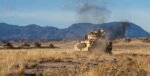
- M-LIDS (Mobile Low-Slow Small UAS Integrated Defeat System): A U.S.-developed mobile C-UAS platform combining radar cueing with kinetic interceptors such as APKWS rockets.
- Coyote Block II interceptors: Raytheon’s expendable drone-hunting loitering munition used for kinetic defeat of small UAVs.
- High-energy laser demonstrators: Directed energy weapons deployed on Stryker platforms for silent engagement of low-altitude drones.
- SPEAR-EW pods: Electronic warfare payloads designed to jam GNSS signals or disrupt RF links between hostile drones and their operators.
The RSAF also showcased indigenous developments including an upgraded version of its SkyGuard system—an integrated radar-optical tracker paired with hard-kill interceptors—and a new mobile electronic attack vehicle optimized for convoy protection against FPV-style kamikaze drones.
Operational Lessons: Interoperability & Kill Chain Integration
A major objective of Red Sands is to validate layered kill chains that combine detection, identification, tracking, disruption/jamming, and kinetic defeat—all within seconds under battlefield conditions. In this year’s drills:
- Joint fire control teams practiced sensor fusion between U.S.-supplied radars (e.g., AN/TPQ-53) and RSAF EO/IR trackers.
- CENTCOM units trialed AI-enabled threat classification algorithms to reduce operator workload during swarm engagements.
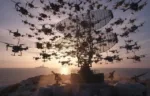
- Live-fire tests demonstrated simultaneous engagement of up to eight inbound drones using mixed-effectors (laser + interceptor).
The exercise also served as a testbed for interoperability protocols such as Link-16 data sharing between coalition air defense nodes—a critical capability given that many Gulf SHORAD assets were procured from non-NATO suppliers with proprietary interfaces.
Evolving Threat Landscape Driving Urgency
The timing of Red Sands aligns with increased regional concern over asymmetric UAV threats:
- Iranian Shahed-series drones, often exported to proxy groups like Hezbollah or Houthis, have been used in attacks on tankers near Hormuz and oil infrastructure deep inside Saudi territory.
- Commercial FPV drones modified for explosive delivery, including DJI-style quadcopters adapted by insurgents in Iraq or Syria using open-source guidance kits.
- Saturation tactics using low-cost swarms, where dozens of $1k-class drones are launched simultaneously to overwhelm radar coverage or exhaust interceptor stocks.
CENTCOM officials emphasized that these trends necessitate not only better hardware but also doctrinal agility—training operators to rapidly switch between soft-kill jamming modes and hard-kill options based on real-time threat profiles.
Future Trajectory: Institutionalizing Joint C-UAS Doctrine
The success of Red Sands has prompted discussions about formalizing it into an annual multilateral event involving other GCC partners such as the UAE or Bahrain. CENTCOM has proposed establishing a permanent Combined Counter-UAS Center of Excellence in Riyadh by late 2026—a facility that would host simulations, wargames, operator training pipelines, and vendor demonstrations year-round.
This would mirror NATO’s approach at Ramstein Air Base for IADS integration but tailored specifically to desert warfare environments where drone use is prolific due to flat terrain visibility and sparse civilian air traffic interference.
Conclusion: From Ad Hoc Defense to Structured Resilience
The third iteration of Exercise Red Sands marks a turning point in how regional militaries approach the drone threat—not merely reacting tactically but building strategic resilience through joint training cycles, shared kill chain architectures, and cross-national technology trials. As low-cost UAVs continue proliferating among adversaries with minimal export controls or technical barriers-to-entry, such exercises will likely become central pillars of modern air defense planning across CENTCOM’s area of responsibility.