US Forces Sharpen Arctic Domain Awareness at NATO in the North Exercise
-
| Defense Systems Analyst

As strategic competition intensifies in the High North, U.S. and allied forces are accelerating efforts to build Arctic operational proficiency. The recent “NATO in the North” exercise held across Alaska showcased integrated multi-domain operations aimed at bolstering domain awareness and readiness in one of the world’s most challenging environments.
Strategic Importance of the Arctic Theater
The Arctic is emerging as a critical geopolitical frontier due to climate change-induced accessibility and increased military activity by Russia and China. Melting sea ice is opening new maritime routes like the Northern Sea Route (NSR), while resource competition over oil, gas, and rare earth elements intensifies. For NATO members with Arctic territory—such as Norway, Canada, Denmark (via Greenland), and the United States—the region demands enhanced situational awareness and rapid response capabilities.
Russia has significantly expanded its military footprint above the Arctic Circle with upgraded airbases (e.g., Nagurskoye), S-400 air defense systems deployments, and increased Northern Fleet patrols. China’s self-declared status as a “near-Arctic state” further complicates regional dynamics.
In this context, exercises like NATO in the North reinforce alliance cohesion while validating cold-weather operational concepts under realistic conditions.
NATO in the North 2025: Scope and Objectives
The 2025 iteration of NATO in the North, conducted primarily across Joint Base Elmendorf-Richardson (JBER) and Eielson Air Force Base in Alaska from October 14–25, involved over 1,200 U.S. service members alongside allied observers from Canada and Norway. The exercise was led by U.S. Northern Command (USNORTHCOM) with support from U.S. Army Alaska (USARAK), Alaskan NORAD Region (ANR), and U.S. Indo-Pacific Command components.
Key objectives included:
- Enhancing Arctic domain awareness through integrated ISR platforms
- Validating Joint All-Domain Command & Control (JADC2) concepts under extreme weather
- Testing communications resilience amid GNSS degradation scenarios
- Improving interoperability between air defense units under NORAD command
- Sustaining logistics chains for forward-deployed units above the Arctic Circle
Tactical Highlights: ISR Integration & Cold-Weather Readiness
A major focus of this year’s exercise was persistent surveillance across vast distances using a layered ISR architecture combining space-based assets (e.g., SBIRS satellites), high-altitude UAVs like RQ-4 Global Hawk operating out of Eielson AFB, manned reconnaissance flights from RC-135 Rivet Joint aircraft based at Offutt AFB temporarily deployed to Alaska, and ground-based radar stations operated by ANR.
The U.S. Army’s use of portable radar systems such as AN/TPQ-53 counterfire radars adapted for snow-covered terrain was also tested for mobility and survivability under sub-zero conditions.
“Operating ISR assets effectively above 66° latitude requires not just sensor capability but robust data fusion across services,” said Col. James Ritter of USARAK G3 Plans during a press briefing.
C2 Resilience Under Harsh Conditions
The exercise tested JADC2 nodes under simulated electromagnetic interference (EMI) scenarios common to high-latitude operations where ionospheric disturbances can degrade satellite comms. Units employed Line-of-Sight (LOS) VHF/UHF radios with encryption modules alongside SATCOM terminals hardened against solar flare-induced outages.
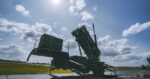
The use of Link-16 tactical datalinks was validated between F-35A fighters from Eielson AFB and Patriot missile batteries deployed near Fort Greely—demonstrating real-time threat data exchange despite intermittent connectivity challenges posed by mountainous terrain.
Sustainment & Mobility Challenges Above the Arctic Circle
Sustainment remains a key vulnerability for extended operations in remote northern regions. During NATO in the North 2025:
- The U.S. Army tested arctic-adapted JLTV variants equipped with auxiliary heaters and snow track kits.
- Aerial resupply missions using CH-47F Chinooks were conducted to simulate delivery of fuel bladders and MRE pallets to forward operating bases near Prudhoe Bay.
- The USAF’s C-130J Super Hercules aircraft practiced short-takeoff-and-landing (STOL) operations on compacted snow runways marked only via GPS waypoints—a contingency approach if traditional airstrips are unavailable due to weather or adversary action.
NORAD Integration & Air Defense Coordination Drills
A critical component was NORAD’s layered air defense simulation involving early warning radars such as AN/FPS-117 long-range surveillance systems feeding into Battle Management Centers at JBER. Simulated intercepts were coordinated between Canadian CF-18 Hornets operating out of Yellowknife AFB via NORAD channels with USAF F-22 Raptors stationed at Elmendorf AFB acting as quick reaction alert (QRA) assets.
This binational integration underscores NORAD’s enduring role as a cornerstone of continental defense amid rising Russian bomber sorties near Alaskan ADIZ boundaries—an occurrence that has spiked since early 2024 according to NORAD public affairs releases.
Future Outlook: Toward an Integrated Arctic Posture
The Department of Defense’s updated “Arctic Strategy” released earlier this year emphasizes persistent presence through rotational deployments rather than permanent basing—citing sustainability concerns. Exercises like NATO in the North serve not only as training events but also capability demonstrations that inform future force posture decisions across NORTHCOM’s area of responsibility.
The Pentagon is also investing heavily into cold-weather gear modernization programs including next-gen ECWCS Gen IV uniforms for infantry units operating below -30°C ambient temperatures—a necessity given forecasted increases in regional deployments through FY2030.
Conclusion: Building Resilience Through Realism
NATO in the North reflects a broader shift toward realism-driven training that accounts for environmental extremes increasingly relevant to global competition dynamics. As peer adversaries expand their reach into polar domains—whether through icebreakers or hypersonic-capable bombers—the ability to detect threats early, communicate securely under duress, move forces rapidly over frozen terrain, and sustain them logistically will define success or failure above the Arctic Circle.