Türkiye’s TCG Anadolu Ushers in Drone-Centric Naval Warfare
-
| Aerospace & UAV Researcher

Türkiye has entered a new era of naval power projection with the commissioning of its first aircraft carrier-like vessel, the TCG Anadolu. Unlike traditional carriers reliant on manned fighter jets, the Anadolu is optimized for unmanned aerial vehicles (UAVs), marking a significant doctrinal and technological shift in maritime warfare. This evolution positions Türkiye as a pioneer in drone-centric naval operations.
TCG Anadolu: From LHD to Drone Carrier
The TCG Anadolu (L-400), commissioned into service in April 2023 by the Turkish Navy, was originally conceived as a landing helicopter dock (LHD) based on Spain’s Juan Carlos I design. Built by Sedef Shipbuilding Inc. under license from Navantia, the vessel displaces approximately 27,000 tons and measures 231 meters in length. While initially intended to operate F-35B STOVL aircraft under NATO interoperability plans, Türkiye’s removal from the F-35 program in 2019 forced a strategic pivot.
In response to this setback and leveraging its burgeoning domestic UAV industry led by Baykar and Turkish Aerospace Industries (TAI), Türkiye reimagined the Anadolu as a drone carrier—a novel concept globally. The ship now serves as a launch and recovery platform for fixed-wing unmanned combat aerial vehicles (UCAVs), rotary-wing drones, and potentially loitering munitions.
Bayraktar TB3: Flagship of Maritime UAV Operations
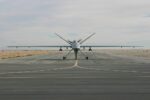
The centerpiece of this transformation is Baykar’s Bayraktar TB3—a navalized evolution of the proven TB2 platform. The TB3 features folding wings for compact storage aboard ships and reinforced landing gear for short takeoff and landing (STOL) on deck surfaces without catapults or arrestor wires. It boasts an endurance exceeding 24 hours and can carry up to 280 kg of payload including precision-guided munitions such as MAM-L/MAM-T smart micro munitions.
Critically, the TB3 incorporates beyond-line-of-sight (BLOS) satellite communications capability via Turkish satellites like Türksat-5B. This enables real-time control over extended ranges—an essential feature for blue-water operations far from shore-based ground stations.
Baykar began flight testing of the TB3 in late 2023. As of mid-2024 reports from Turkish defense media indicate successful short-deck takeoffs have been demonstrated from land-based mockups simulating Anadolu’s deck geometry. Sea trials aboard TCG Anadolu are expected to commence later in 2024 or early 2025.
Operational Doctrine: Distributed Lethality with Drones
The integration of long-endurance UCAVs aboard an amphibious assault ship opens new doctrinal possibilities for Türkiye’s Navy:
- Persistent ISR: Drones can provide continuous intelligence-surveillance-reconnaissance coverage over littoral or contested maritime zones without risking manned assets.
- Precision Strike: Armed UAVs offer strike capabilities against surface vessels or coastal targets using guided munitions launched from standoff ranges.
- Saturation Attacks: Swarm tactics using multiple drones could overwhelm enemy air defenses or surface combatants—particularly useful against asymmetric threats.
- C4ISR Relay: UAVs can act as airborne relays extending tactical data links between dispersed naval units operating under EMCON conditions.
This approach aligns with NATO trends toward distributed lethality and unmanned-manned teaming but pushes them further by making drones—not manned fighters—the primary aviation component aboard a capital ship.
Tactical Integration Challenges and Innovations
The drone carrier concept introduces several technical hurdles that Türkiye is actively addressing:
- Deck Handling: Folding-wing UCAVs require new procedures for launch/recovery cycles on limited deck space traditionally optimized for helicopters or STOVL jets.
- C2 Bandwidth Management: Operating multiple BLOS-capable drones simultaneously demands robust satellite communications bandwidth allocation and deconfliction protocols—especially during high-tempo operations.
- EMI/EMC Considerations: The electromagnetic environment aboard ships must be carefully managed to prevent interference between drone comms systems and onboard radar/electronic warfare suites such as Aselsan’s MAR-D radar or HAVELSAN’s ADVENT combat management system.
Toward this end, Turkish firms like Roketsan are also developing compact vertical launch systems (VLS) that could eventually enable drones to cue ship-launched missiles via cooperative engagement networks—a capability akin to U.S. Navy NIFC-CA architecture but adapted for unmanned platforms.
A Regional Force Multiplier—and Export Model?
The TCG Anadolu significantly enhances Türkiye’s ability to project power across the Eastern Mediterranean, Aegean Sea, Red Sea corridor, and even into sub-Saharan Africa via port access agreements with African states. Its drone-centric configuration allows persistent presence without risking pilots or expensive manned aircraft fleets—ideal for gray zone operations short of full conflict escalation.
Anadolu also serves as a showcase platform for exporting integrated naval-UAV packages. Several countries—including Pakistan and Indonesia—have reportedly expressed interest in similar configurations combining amphibious ships with indigenous UCAV capabilities tailored to regional needs where air superiority cannot be guaranteed ashore.
The Future: MIUS Kızılelma on Deck?
A longer-term ambition involves deploying jet-powered unmanned combat aircraft such as Baykar’s MIUS Kızılelma—a stealthy supersonic UCAV currently undergoing flight testing since late 2023—aboard future iterations of drone carriers or upgraded versions of Anadolu-class vessels. While current deck strength may limit immediate deployment due to higher takeoff/landing loads compared to propeller-driven TB3s, modular upgrades including ski-jumps or arrestor nets are being studied by STM Defense Technologies Group and TÜBİTAK SAGE engineers.
Conclusion
The TCG Anadolu represents more than just Türkiye’s first aircraft carrier—it embodies a paradigm shift toward unmanned maritime aviation that few navies have yet operationalized at scale. By integrating long-endurance armed drones into its fleet doctrine via an indigenous industrial base spanning airframes to C4ISR systems, Türkiye is carving out a unique niche in future naval warfare concepts centered around autonomy and survivability at sea.