Heavy-Lift Autonomy: Titra’s T1400 Tandem Uncrewed Helicopter Completes Maiden Flight
-
| Defense Systems Analyst

Turkish defense-tech company Titra has successfully flown its new heavy-lift uncrewed helicopter, the T1400. Designed around a tandem rotor configuration reminiscent of the CH-47 Chinook, the autonomous vertical takeoff and landing (VTOL) system is intended for ISR and logistics missions in contested environments. The milestone marks Turkey’s growing ambitions in next-generation unmanned aviation platforms.
Maiden Flight Demonstrates Core Capabilities
The first flight of the T1400 took place in Ankara in early October 2025. According to official statements from Titra and Turkish defense sources, the test validated key flight envelope parameters including hover stability, basic maneuvering, and autonomous control systems integration. No major anomalies were reported during the sortie.
The aircraft is powered by two internal combustion engines driving a tandem rotor system—an uncommon configuration among UAVs but one that offers superior lift efficiency and center-of-gravity tolerance for heavy payloads. The use of this architecture allows the T1400 to carry up to 250 kg of payload over operational ranges exceeding 400 km.
Design Rationale: Tandem Rotor for Tactical Logistics
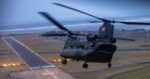
The choice of a tandem rotor layout—rare outside of manned heavy-lift helicopters like the CH-47—reflects a deliberate design decision aimed at maximizing lift-to-weight ratio while maintaining compactness for shipboard or confined-area operations. Unlike coaxial or single-rotor UAVs with tail rotors, tandem rotors eliminate torque-induced yaw issues and allow all engine power to be directed toward lift and propulsion.
This makes the platform ideal for tactical resupply missions in mountainous or austere terrain where conventional fixed-wing drones cannot land. Additionally, tandem rotorcraft offer better longitudinal stability when carrying underslung loads or modular cargo pods.
Mission Profiles: ISR and Beyond-Line-of-Sight Resupply
Titra envisions multiple mission sets for the T1400:
- Autonomous logistics: The primary use case is point-to-point resupply under GPS-denied or contested conditions. With its VTOL capability and high payload tolerance, it can deliver ammunition, fuel bladders, medical supplies or even small UGVs directly to frontline units without exposing human pilots to risk.
- ISR operations: The airframe can be fitted with EO/IR gimbals or synthetic aperture radar (SAR) pods for persistent surveillance over border zones or maritime chokepoints. Its endurance profile supports loitering missions exceeding several hours depending on payload weight.
- Civilian applications: Firefighting support via water bucket delivery or post-disaster humanitarian relief are also possible roles under dual-use export strategies.
Autonomy Stack & System Integration
The autonomy suite onboard the T1400 includes GNSS-aided inertial navigation systems (INS), obstacle avoidance sensors (likely LIDAR-based), terrain-following algorithms, and redundant flight control computers developed by local Turkish avionics firms. While full Level-5 autonomy (no human oversight) has not been confirmed yet, current capabilities include semi-autonomous waypoint navigation with real-time datalink fallback via SATCOM or LOS radio.
Titra has not disclosed whether NATO-standard protocols such as STANAG-compliant C4ISR integration are supported yet—but given Turkey’s recent emphasis on interoperability within its indigenous drone ecosystem (e.g., Bayraktar TB3), it is likely that Link-16 or equivalent data relay standards are being considered for future upgrades.
Positioning Within Turkey’s Expanding UAV Ecosystem
The debut of the T1400 aligns with Ankara’s strategic push into diversified uncrewed platforms across air domains—from MALE UCAVs like Akinci to loitering munitions such as Kargu. With Baykar leading fixed-wing systems development and Aselsan focusing on sensor payloads, firms like Titra are carving out niches in rotary-wing autonomy where global competition remains limited.
This vertical integration strategy gives Turkey greater resilience against export controls while enabling tailored solutions for asymmetric warfare environments like Syria or Libya where runway access is constrained but aerial mobility remains critical.
Outlook: Challenges Ahead Before Operational Fielding
Despite a successful first flight, several hurdles remain before the T1400 sees operational deployment:
- Maturity of autonomy stack: Real-world performance under EW/GNSS-jamming conditions must be validated through field trials.
- Cargo handling systems: Modular pod integration with quick-release mechanisms will be essential for fast turnaround in combat resupply scenarios.
- CERTIFICATION & EXPORT: Civil-military certification pathways under Turkish SSB guidelines will determine how quickly allied nations can procure variants of the platform.
- Sustainment & MRO footprint: Given its twin-engine design and mechanical complexity versus quadcopter drones, maintenance requirements may limit scalability unless addressed via modular subsystems.
A Niche Yet Strategic Capability
If successfully matured into an operational platform within two to three years—as projected by industry insiders—the Titra T1400 could fill a critical gap between lightweight quadrotor drones (<50 kg) and large HALE-class platforms unsuitable for tactical use. Its ability to autonomously deliver meaningful payloads across rugged terrain without runways would provide Turkish forces—and potentially export customers—with enhanced logistical reach under fire.