Thales Unveils Low-Cost Laser-Guided C-UAS Rocket Tailored for Ukraine’s Battlefield Needs
-
| Defense Systems Analyst

As Ukraine faces an evolving threat from massed loitering munitions and first-person-view (FPV) drones, Thales has unveiled a new low-cost laser-guided counter-unmanned aerial system (C-UAS) solution. Designed around the widely available 70 mm Hydra rocket architecture, the new interceptor aims to provide a scalable and affordable air defense option against small UAS threats.
Hydra 70-Based Interceptor with Precision Guidance
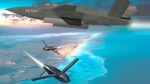
The core of Thales’ new C-UAS solution is a modified version of the ubiquitous 70 mm (2.75-inch) Hydra rocket—originally developed in the United States and fielded globally in both rotary-wing and ground-based applications. Thales has equipped this legacy munition with a semi-active laser seeker and guidance kit to transform it into a precision-guided interceptor capable of engaging Group 1–2 UAVs such as quadcopters and loitering munitions.
According to official statements and reporting by UAS Vision (Oct 2025), each guided round is expected to cost approximately $10,000—a fraction of the price of traditional surface-to-air missiles or even some advanced drone-on-drone interceptors. This cost-efficiency is critical in high-volume drone conflict environments like Ukraine, where adversaries deploy swarms of cheap FPV drones costing as little as $500–$1,000 apiece.
The system leverages existing NATO-standard Hydra launchers and can be mounted on light vehicles or static positions. The seeker reportedly uses semi-active laser homing (SALH), requiring target designation via ground-based or airborne laser designators—either manned or automated.
Operational Context: Drone Saturation Drives Demand
Ukraine’s battlefield experience since early 2023 has demonstrated that traditional air defense systems—such as NASAMS or IRIS-T SLM—are overkill when used against small quadcopters or Shahed-type loitering munitions. These high-end systems are better reserved for cruise missiles or fixed-wing aircraft threats.
This operational mismatch has fueled demand for short-range, low-cost kinetic options that can be deployed en masse. Ukrainian forces have increasingly relied on small arms fire, electronic warfare (EW), and jury-rigged solutions such as truck-mounted autocannons—but these have limited effectiveness against fast-moving or GPS-denied drones.
By offering a guided munition at one-tenth the cost of traditional interceptors—and with greater precision than unguided AAA—the Thales rocket fills an urgent capability gap in layered SHORAD architecture tailored to modern drone warfare.
Modularity and Deployment Flexibility
The use of standard Hydra tubes allows rapid integration onto various platforms without bespoke launchers. In addition to ground vehicles like MRAPs or technicals equipped with lightweight pods (e.g., LAU-68), the system could potentially be adapted to rotary-wing aircraft or naval platforms for close-in defense roles.
This modularity also supports distributed defense concepts where multiple mobile teams can cover wide frontlines using portable launchers paired with handheld laser designators or networked UAVs acting as forward observers/designators.
Importantly, because the guidance kit is modular and can be retrofitted onto existing stocks of unguided rockets, it offers logistics advantages for countries already operating large inventories of Hydra-class munitions—including NATO members supporting Ukraine under EDA/FMS frameworks.
C-UAS Effectiveness Against FPV Drones
The key challenge in intercepting FPV drones lies in their small radar cross-section (RCS), erratic flight paths, and low-altitude profiles—often below tree lines. Traditional radar-guided systems struggle under these conditions unless paired with advanced EO/IR sensors and AI-based tracking algorithms.
Semi-active laser guidance circumvents this by enabling human-in-the-loop targeting via visual acquisition—especially effective when combined with thermal optics or AI-enhanced targeting software. The Hydra-based interceptor’s speed (~Mach 2+) ensures minimal time-to-target once lock-on is achieved within its effective range (~5–7 km).
While not autonomous like some emerging drone-on-drone systems (e.g., Rheinmetall’s Skyranger30 + AI-enabled quadcopters), this solution offers greater reliability under contested spectrum conditions where GPS jamming may neutralize autonomous seekers reliant on GNSS data.
Comparison With Other Low-Cost Interceptors
A number of Western firms are racing to develop affordable C-UAS interceptors:
- Raytheon’s Coyote Block 3: A tube-launched expendable UAV interceptor with onboard radar homing; costs estimated at ~$100K per unit.
- DARPA’s Mobile Force Protection Program: Includes hard-kill drone interceptors launched from mobile platforms; still in prototype phase.
- L3Harris VAMPIRE system: Uses APKWS II guided rockets launched from pickup trucks; similar concept but higher per-shot cost (~$27K).
The Thales solution undercuts these programs significantly on unit price while leveraging off-the-shelf components already field-proven across NATO arsenals. Its main tradeoff is reliance on external designation rather than autonomous terminal guidance—but this may be acceptable given Ukraine’s extensive use of UAV spotters already integrated into its kill chain processes via apps like Kropyva/Delta.
Status and Prospects for Ukrainian Fielding
No formal contract has been announced between Thales and Ukrainian MOD as of October 2025; however, sources suggest prototypes have been tested in European proving grounds since mid-2024. Given France’s active military aid posture toward Kyiv—including delivery of Caesar howitzers and GM200 radars—it is plausible that initial batches could be delivered under bilateral assistance frameworks or EU funding mechanisms such as the European Peace Facility (EPF).
If successful in combat trials—and assuming sufficient production ramp-up—the system could become part of a broader SHORAD ecosystem alongside EW jammers (e.g., EDM4S-UA), gun-based solutions (ZSU-23-4 Shilka upgrades), MANPADS teams using IR missiles like Stinger/Piorun, and emerging anti-drone net/missile hybrids being tested by NATO partners.
Conclusion: A Tactical Solution With Strategic Implications
The introduction of an affordable precision-guided C-UAS munition by Thales represents more than just another product—it reflects a doctrinal shift toward scalable air defense tailored to asymmetric threats posed by mass drone usage. For nations supporting Ukraine—or preparing their own forces for future conflicts involving saturation UAS attacks—the ability to field hundreds or thousands of $10K guided rockets may prove decisive both tactically and economically.