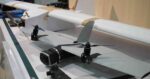
Teledyne FLIR Boson Thermal Camera Enhances SYPAQ’s CorvoX Capabilities for Australian Army ISR Missions
-
| Aerospace & UAV Researcher

Milivox analysis: The integration of Teledyne FLIR’s Boson thermal camera into SYPAQ’s CorvoX UAV marks a significant upgrade in Australia’s tactical ISR capabilities. This pairing enhances day-night reconnaissance performance and aligns with broader trends in lightweight sensor-payload fusion for low-cost autonomous platforms.
Background
SYPAQ Systems, an Australian defense technology company best known for its cardboard-based Precision Payload Delivery System (PPDS), has expanded its unmanned aerial vehicle (UAV) portfolio with the CorvoX—a fixed-wing electric vertical takeoff and landing (eVTOL) drone designed for intelligence, surveillance, and reconnaissance (ISR) missions. In October 2023, the company announced a partnership with Teledyne FLIR Defense to integrate the compact Boson thermal imaging module into the CorvoX platform.
The collaboration was showcased at Land Forces 2024 in Melbourne and is part of a broader push by the Australian Department of Defence to enhance sovereign drone capabilities under its Advanced Strategic Capabilities Accelerator (ASCA) initiative. The move reflects Canberra’s increasing focus on autonomous systems tailored to Indo-Pacific operational requirements.
Technical Overview
The Teledyne FLIR Boson is a lightweight uncooled longwave infrared (LWIR) camera core that offers high-resolution thermal imaging in a compact form factor. Available in resolutions up to 640×512 pixels with frame rates up to 60 Hz, the Boson supports both analog and digital video outputs and features onboard image processing via Teledyne’s proprietary XIR™ architecture.
Key specifications include:
- Sensor Type: Uncooled VOx microbolometer
- Spectral Band: 7.5 – 13.5 µm LWIR
- Resolution Options: 320×256 or 640×512
- Weight: ~25 grams (core only)
- Power Consumption: ~0.85W typical
- Lenses: Multiple FOV options from narrow to wide-angle
- Interfaces: USB, CMOS/LVDS video output, UART/GPIO control
This makes it well-suited for small Group I/II UAVs like the CorvoX that require low-SWaP (Size, Weight and Power) payloads without compromising on imaging fidelity. The integration enables real-time thermal video feed transmission over encrypted datalinks for day/night operations in contested environments.
Operational or Strategic Context
The enhanced CorvoX platform is aimed at tactical ISR roles including route reconnaissance, perimeter security overwatch, target acquisition support for indirect fires units, and post-strike battle damage assessment (BDA). Its eVTOL design allows launch/recovery from confined areas such as jungle clearings or urban rooftops—key advantages in Australia’s northern approaches or potential Pacific deployments.
The addition of a high-performance thermal imager significantly expands mission flexibility under degraded visual environments such as smoke-obscured battlefields or night operations—a capability gap identified during recent ADF exercises like Talisman Sabre.
This development also aligns with global trends observed in Ukraine and elsewhere where low-cost UAVs equipped with EO/IR sensors are being used extensively for artillery spotting and FPV strike coordination. As assessed by Milivox experts, Australia is investing in similar asymmetric enablers to counter peer threats across vast maritime domains.
Market or Industry Impact
The integration underscores growing demand for modular sensor payloads compatible with small UAV platforms across NATO-aligned forces. For Teledyne FLIR Defense—a subsidiary of Teledyne Technologies Inc.—the deal strengthens its position in the Asia-Pacific unmanned systems market where competition from Israeli and European sensor OEMs remains intense.
SYPAQ’s approach focuses on sovereign design-to-deploy cycles within Australia’s industrial base—an advantage as Canberra seeks to reduce reliance on foreign suppliers amid tightening export controls globally. The CorvoX platform itself is expected to enter limited operational evaluation within select ADF units by mid-2025 under ASCA-funded trials.
Milivox Commentary
This partnership illustrates how mature commercial-off-the-shelf (COTS) sensor technologies like the Boson can be rapidly militarized when paired with agile drone platforms designed domestically. While not revolutionary individually, such integrations represent force multipliers when deployed at scale—as seen with Ukraine’s use of massed FPV drones augmented by EO/thermal feeds.
The key challenge will be ensuring secure communications resilience and robust data encryption as these drones operate closer to frontlines or within EW-contested zones—a lesson learned from recent conflicts where GNSS spoofing disrupted unprotected C2 links.
If successful during fielding trials, Milivox assesses that this configuration could serve as a blueprint for other Five Eyes partners seeking affordable yet capable ISR drones built around sovereign supply chains and proven sensor cores like those from Teledyne FLIR.