Taiwan’s Tan Chiang Corvette Begins Sea Trials: Asymmetric Naval Power on Display
-
| Defense Industry & Geopolitics Observer

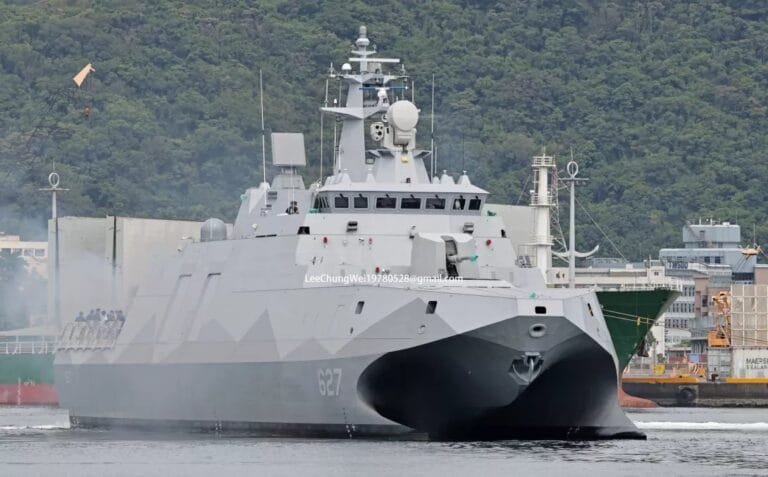
Taiwan has begun sea trials of its new-generation Flight II corvette Tan Chiang, the lead ship of a follow-on series to the Tuo Chiang-class “carrier killers.” The move underscores Taipei’s strategy of building a larger, faster, missile-heavy littoral fleet to counter the PLA Navy (PLAN). Designed for hit-and-run strikes with stealth shaping, advanced sensors, and indigenous weapons, Tan Chiang symbolizes Taiwan’s growing confidence in local shipbuilding and its asymmetric approach to maritime security.
1. The Ship: Evolution of the Tuo Chiang Concept
The Tan Chiang is not a clean-sheet design but a Flight II evolution of the original Tuo Chiang-class (commissioned 2014). Where the first batch demonstrated proof of concept, Flight II corvettes scale up capabilities for high-intensity operations.
Key Features:
-
Stealth shaping: Angled hull and superstructure to reduce radar cross-section.
-
High speed: Reportedly up to 45 knots, enabling fast repositioning in littoral waters.
-
Armament: Expected loadout includes Hsiung Feng II/III anti-ship missiles, surface-to-air missiles, and 76mm main gun.
-
Sensors: Upgraded radar and EO/IR suites for multi-target tracking.
-
Crew: Approx. 41–50 sailors, optimized for reduced manning.
Compared to the first Flight I ships, Tan Chiang brings improved seakeeping and expanded mission flexibility.
2. Why This Matters for Taiwan’s Defense
The asymmetric logic
Taiwan cannot match the PLAN in capital ships or fleet size. Instead, Taipei is pursuing a distributed, missile-heavy fleet of fast attack craft, corvettes, and coastal missile batteries. The Tan Chiang exemplifies this strategy: low-observable, fast, and packed with precision missiles capable of threatening larger PLA ships at standoff ranges.
Deterrence signaling
By showcasing Tan Chiang during sea trials, Taiwan highlights both industrial progress and resolve to field systems optimized for a “denial by punishment” doctrine—making any blockade or invasion fleet vulnerable.
3. Industrial and Strategic Context
-
Local build: The corvette is constructed by Taiwan’s Lung Teh Shipbuilding Co., part of a national push for indigenous defense production.
-
Program scale: Taiwan reportedly plans up to 12 ships in this class, with staggered commissioning through the late 2020s.
-
Political backdrop: The sea trial occurs amid rising Chinese military exercises near Taiwan’s ADIZ and waters. The timing signals readiness and resolve.
4. Operational Scenarios
-
Coastal defense: Rapid dispersal from concealed ports, ambushing PLAN surface groups.
-
Sea denial: Saturation strikes using Hsiung Feng III supersonic missiles against larger targets like destroyers and amphibs.
-
Air defense integration: Layered coverage when operating with land-based SAMs and friendly fighters.
-
Grey-zone response: Presence patrols and escalation control without committing scarce major combatants.
5. Risks and Challenges
-
Survivability trade-off: While fast and stealthy, corvettes are still vulnerable to PLAN’s long-range missiles and carrier aviation.
-
Magazine depth: Limited missile load compared to PLAN warships. Effectiveness depends on coordinated salvo tactics.
-
Industrial tempo: Building 12 ships on schedule strains Taiwan’s limited yards. Sustaining high-quality output remains a challenge.
-
Operational doctrine: Requires networked C4ISR for maximum effect—without integration, corvettes risk isolation and attrition.