Sweden Threatens to Engage Russian Aircraft Violating Airspace: Strategic Posture Shift Amid NATO Accession
-
| Defense Systems Analyst

In a significant escalation of its defense posture, Sweden has publicly declared that it is prepared to shoot down Russian military aircraft that violate its sovereign airspace. The statement marks a strategic shift in Sweden’s rules of engagement (ROE) following its full accession to NATO in March 2024 and comes amid increased Russian aerial provocations over the Baltic Sea region.
Swedish Rules of Engagement Harden After NATO Entry
On 13 September 2025, Swedish Armed Forces Supreme Commander General Micael Bydén stated unequivocally that Sweden will no longer tolerate violations of its airspace and is prepared to use force against intruding aircraft. “If a Russian plane violates Swedish airspace again, we will not hesitate to engage,” Bydén said during an interview with SVT Nyheter.
This declaration represents a notable tightening of Sweden’s ROE. Historically non-aligned and cautious in military responses, Stockholm had previously relied on intercepts and diplomatic protests when dealing with airspace incursions. However, since joining NATO under Article 5 protections earlier this year, Sweden has begun aligning its air defense posture with alliance standards—emphasizing deterrence through credible threat of force.
Bydén’s comments follow a series of provocative actions by the Russian Aerospace Forces (VKS), including multiple instances of Su-24 and Su-27 fighters entering or approaching Swedish airspace without transponders or flight plans. These incidents have typically occurred near Gotland or over the Baltic Sea’s Kaliningrad-adjacent flight corridors.
Gripen Force on High Alert Along Baltic Flank
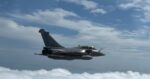
To enforce its new posture, the Swedish Air Force has significantly increased readiness levels for its JAS 39 Gripen fleet. The multi-role fighter jets—operated from bases such as F 17 Kallinge and F 21 Luleå—are now conducting more frequent QRA (Quick Reaction Alert) sorties under integrated NATO Baltic Air Policing protocols.
- JAS 39C/D Gripen: Currently the backbone of Sweden’s fighter force; equipped with PS-05/A radar and IRIS-T/AMRAAM missiles for BVR/within-visual-range engagements.
- NATO Interoperability: Gripens are Link-16 capable and fully integrated into NATO C2 networks via CAOC Uedem (Germany).
- Basing Strategy: Dispersed operations remain central; highway-based launches and hardened shelters are being reactivated across southern Sweden.
The Swedish Defence Materiel Administration (FMV) also confirmed ongoing upgrades to Gripen E variants under procurement contracts with Saab AB. These include AESA radar integration (Leonardo ES-05 Raven), enhanced EW suites, and Meteor long-range missile capability—further boosting deterrence against high-speed intruders like Russia’s MiG-31 or Su-35S platforms.
Baltic Airspace Tensions Continue to Rise
The Baltic region remains one of Europe’s most volatile aerial flashpoints. According to NATO Allied Air Command data from Q3 2025, over 300 intercepts were conducted by alliance aircraft responding to uncoordinated Russian flights near Estonian, Latvian, Lithuanian—and increasingly—Finnish and Swedish FIRs (Flight Information Regions).
Moscow has not formally responded to Bydén’s remarks but continues routine patrols from Kaliningrad’s Chkalovsk airbase using VKS assets such as Tu-22M3 bombers escorted by Su-30SM fighters. These flights often probe ADIZ boundaries without filing flight plans or activating IFF transponders—a practice widely seen as deliberate gray-zone pressure tactics.
The recent deployment of S-400 systems in Kaliningrad Oblast further complicates regional dynamics by extending Russia’s A2/AD envelope deep into allied air corridors. In response, Sweden is coordinating closely with Finland—another recent NATO entrant—to harmonize sensor coverage via joint radar networks and cross-border QRA protocols.
NATO Integration Drives C4ISR Modernization
Sweden’s shift toward more assertive ROE is underpinned by rapid modernization across command-and-control (C2) infrastructure. The Försvarsmakten has accelerated integration into NATO’s C4ISR architecture through several key initiatives:
- NORDEFCO Data Sharing: Real-time sensor fusion between Nordic nations enables early warning across shared radar grids.
- NATO ACCS Compatibility: Sweden is upgrading national command centers for full interoperability with the Alliance’s Air Command & Control System (ACCS).
- SIGINT Expansion: FRA (National Defence Radio Establishment) has expanded airborne ELINT missions using Gulfstream-based S102B Korpen platforms over the Baltic corridor.
This network-centric approach ensures faster decision loops for intercept authorization—a critical factor if future intrusions require kinetic engagement within seconds rather than minutes.
A Deterrent Message—or Precursor to Escalation?
While General Bydén framed his statement as defensive deterrence rather than provocation, some analysts warn that formalizing shootdown threats could increase risk in an already tense environment where miscalculation is possible. RAND Corporation analyst Eva Hagström noted that “the line between signaling resolve and triggering escalation can be razor-thin when dealing with fast-moving aerial encounters.”
The announcement also raises questions about burden-sharing within NATO’s northern flank. With Finland focusing on defending Lapland and Norway preoccupied with Arctic surveillance gaps, Sweden may become the de facto lead nation for Baltic Sea aerial security—a role it appears increasingly willing to assume both politically and operationally.
Outlook: From Neutrality to Forward Deterrence
This shift underscores how fundamentally Sweden’s strategic culture has evolved since Russia’s full-scale invasion of Ukraine in February 2022. Once staunchly non-aligned—even during Cold War peaks—Stockholm now embraces forward deterrence doctrines aligned with broader NATO posture shifts toward Russia containment along the eastern flank.
If enforced consistently, Sweden’s new ROE could serve as a regional stabilizer by deterring further provocations—or conversely—as a trigger point if Moscow tests resolve too far. Either way, the era of passive neutrality appears definitively over for Stockholm’s skies.