Sweden Orders Saab’s Common Launcher to Unify Gripen C/D and E Fleets Ahead of NATO Integration
-
| Aerospace & UAV Researcher

Milivox analysis: Sweden has contracted Saab to develop a new Smart Launcher Adapter Unit (SLAU) that will enable cross-platform weapons compatibility between its legacy Gripen C/D fighters and the newer Gripen E. This move is strategically aligned with Sweden’s recent accession to NATO and reflects a broader shift toward standardization and interoperability in Nordic airpower.
Background
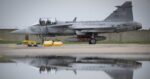
On the heels of its formal entry into NATO in March 2024, Sweden is accelerating modernization efforts across its defense forces. A key component of this transformation is ensuring that its mixed fleet of JAS 39 Gripen fighters — comprising both the older C/D models and the more advanced E variant — can operate seamlessly with standardized weapon loads.
To this end, the Swedish Defence Materiel Administration (FMV) has awarded a contract to Saab for the development and production of a new launcher system known as the Smart Launcher Adapter Unit (SLAU). The SLAU will allow common air-to-air missile integration across both aircraft types — particularly for weapons like MBDA’s Meteor beyond-visual-range air-to-air missile (BVRAAM) and Diehl Defence’s IRIS-T short-range missile.
This development comes as Sweden prepares to contribute more actively to NATO’s Integrated Air and Missile Defence posture in Northern Europe. Standardizing weapon interfaces across fighter platforms reduces logistical complexity while enhancing operational flexibility during joint missions.
Technical Overview
The SLAU is designed as a modular smart launcher that complies with MIL-STD-1760 standards for electrical interface between aircraft and stores. According to Saab’s official release on November 7, 2025, the unit will be capable of carrying both IRIS-T and Meteor missiles without requiring platform-specific modifications or separate launchers.
- Compatibility: Gripen C/D and Gripen E
- Supported Missiles: MBDA Meteor BVRAAM; Diehl IRIS-T SRAAM
- Interface Standard: MIL-STD-1760
- Functionality: Power supply management, data link control (e.g., for Meteor’s active radar seeker), health status monitoring
- Status: Development phase initiated; delivery planned before full IOC of Sweden’s upgraded air force posture within NATO
The SLAU effectively replaces older pylon-specific launchers used on the Gripen C/D fleet while aligning with the digital architecture of the Gripen E. The latter features an all-new avionics suite built around sensor fusion and open mission systems — making unified launcher integration both feasible and tactically advantageous.
Operational or Strategic Context
The decision to unify missile launchers across fighter variants offers several strategic benefits. First, it simplifies logistics by reducing spare parts inventories. Second, it enables rapid reconfiguration of aircraft depending on mission profiles — whether homeland defense under NATO Air Policing or expeditionary deployments in support of Baltic allies.
This move also reflects broader trends in European airpower standardization. Finland — which also joined NATO in April 2023 — has ordered F-35A fighters equipped with similar smart pylons compatible with AIM-120 AMRAAMs and other Western munitions. By contrast, legacy fleets often suffer from siloed integration paths that hinder multinational operations.
The SLAU also ensures that Sweden can maintain full operational capability even if some aircraft are grounded or rotated out for maintenance — since any available jet can be loaded with either short-range or long-range AAMs using a common interface.
Market or Industry Impact
This contract strengthens Saab’s position as not only an airframe OEM but also a critical systems integrator within Europe’s defense ecosystem. While no contract value was disclosed publicly by FMV or Saab at time of writing, Milivox assesses this development may open up export opportunities for SLAU-equipped launchers beyond Sweden.
- Czech Republic: Currently operates Gripen C/D; could benefit from launcher upgrades if transitioning toward mixed fleets or extended service life programs.
- Brazil: Operates Gripen E; potential buyer if considering backward compatibility kits for future partners in Latin America.
- NATO Interoperability Programs: Could adopt similar launcher architectures under European Sky Shield Initiative (ESSI) frameworks focused on integrated air defense layers.
The modularity principle behind SLAU aligns with current industry trends emphasizing plug-and-play capabilities under open architecture mandates such as MOSA (Modular Open Systems Approach). This could position Saab favorably in future multinational fighter upgrade programs where weapons integration timelines are often critical path items.
Milivox Commentary
As assessed by Milivox experts, Sweden’s investment in a common smart launcher underscores how even relatively small hardware changes can yield outsized strategic effects when aligned with alliance requirements. In practical terms, this means faster sortie generation rates during high-tempo operations and reduced training burdens for ground crews handling munitions loading procedures across different aircraft types.
This initiative also reflects how non-stealth platforms like the Gripen continue evolving through incremental upgrades rather than wholesale replacements. By focusing on networked survivability — including long-range BVRAAMs like Meteor launched from dispersed platforms — Sweden enhances deterrence without over-relying on expensive fifth-gen assets alone.