Pakistan’s New Hovercraft Fleet Enhances Coastal Defense Agility and Amphibious Reach
-
| Defense Industry & Geopolitics Observer

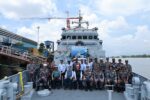
In a significant boost to its littoral warfare and rapid-response capabilities, the Pakistan Navy has inducted new high-speed hovercraft into its fleet. These vessels—reportedly based on the Soviet-era Zubr-class design—are tailored for amphibious operations and coastal defense missions. The acquisition reflects Islamabad’s growing focus on enhancing mobility and flexibility across its 1,046-kilometer coastline in response to evolving regional maritime dynamics.
Strategic Context: Littoral Warfare in the Arabian Sea
Pakistan’s maritime strategy has long prioritized sea denial and coastal defense over blue-water power projection. With India expanding its naval footprint in the Indian Ocean Region (IOR), including enhanced amphibious capabilities via platforms like INS Jalashwa and upcoming LPDs under Project 17A, Pakistan is seeking asymmetric counters to maintain deterrence in its near seas.
The induction of these hovercraft aligns with this doctrine by enabling fast troop transport, logistics support to forward positions, and rapid response along Pakistan’s vulnerable Makran coast—particularly around strategic nodes like Gwadar Port. Hovercraft can operate across beaches and marshes where traditional landing craft or patrol boats are limited.
Capabilities of the New Hovercraft
While official specifications have not been disclosed by Pakistan’s Ministry of Defence Production (MoDP), open-source imagery from commissioning ceremonies at Karachi Naval Dockyard suggests that these vessels are derivatives or licensed variants of the Chinese Type 958 (Zubr-class), originally developed by Ukraine and Russia as Project 1232.2 “Zubr.”
The original Zubr-class is the world’s largest military hovercraft class with a full-load displacement of ~555 tons. It can carry:
- Up to 3 main battle tanks (~50 tonnes each), or
- 10 armored personnel carriers (APCs) with ~140 troops
Their typical top speed exceeds 60 knots (~110 km/h), making them ideal for fast beach landings or interdiction missions. They feature bow ramps for rapid offloading and can traverse up to 400 km without refueling.
It remains unclear whether Pakistan’s variant retains full Zubr specifications or is a scaled-down derivative optimized for regional needs. Some analysts suggest it may be more akin to China’s Type 726 Yuyi-class LCACs used aboard PLA Navy amphibious ships but adapted for independent shore-based operations.
China-Pakistan Defense Industrial Synergy
This procurement underscores deepening naval-industrial ties between China and Pakistan. The hovercraft were reportedly built at Jiangnan Shipyard Group under NORINCO or CSIC supervision before being transferred via sea lift. Similar cooperation has produced F-22P frigates (Zulfiquar-class) and Hangor-class submarines based on China’s S26 design.
The decision to acquire hovercraft from China rather than refurbish legacy Western platforms reflects both geopolitical alignment and sanctions-related constraints post-1990s Pressler Amendment fallout. Moreover, Chinese systems offer cost-effective solutions with flexible export licensing terms—a key factor given Pakistan’s limited naval modernization budget.
Tactical Roles: From Troop Lift to ISR Support
The new hovercraft fleet will likely be operated by Pakistan Marines under Coastal Command HQ based in Karachi. Their primary missions include:
- Rapid deployment of marine infantry along remote shores
- Logistics resupply during amphibious exercises or crises
- Support for humanitarian assistance/disaster relief (HADR)
- Littoral ISR using onboard EO/IR sensors or UAV launch pads
If equipped with basic self-defense systems—such as HMG mounts or MANPADS stations—they could also perform limited interdiction roles against small surface threats like fast attack craft (FAC).
Operational Implications for Regional Maritime Balance
The addition of high-speed air-cushion vehicles enhances Pakistan’s ability to conduct distributed operations across dispersed littoral zones—a concept increasingly emphasized in modern naval doctrine globally (e.g., USMC Force Design 2030).
This capability could complicate Indian naval planning during potential contingencies by forcing greater allocation of surveillance assets along less predictable axes of approach near Sir Creek or Balochistan coastlines.
Future Outlook: Towards an Integrated Amphibious Force?
If successful operationally, these hovercraft may serve as a stepping stone toward broader amphibious force development within the Pakistan Navy-Marine Corps structure. This could include integration with UAV reconnaissance assets like ScanEagle derivatives or indigenous surveillance drones such as Shahpar-II for real-time targeting support.
A future roadmap might also involve modular upgrades—such as C4ISR terminals compatible with Link-16 analogues—or joint exercises with PLAN Marine units under the China-Pakistan Strategic Partnership framework.