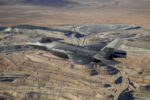
NASA’s X-59 Quiet Supersonic Jet Takes Flight, Reviving Hopes for Civil Supersonic Travel
-
| Aerospace & UAV Researcher

Milivox analysis: NASA’s X-59 QueSST demonstrator has entered its flight test phase in California, marking a pivotal milestone in the agency’s effort to re-enable commercial supersonic travel over land. Designed by Lockheed Martin Skunk Works under NASA’s Low-Boom Flight Demonstration program, the X-59 seeks to validate technologies that reduce sonic booms to tolerable “thumps,” potentially overturning decades-old regulatory bans.
Background
Since the retirement of Concorde in 2003 and the imposition of international bans on supersonic overland flights due to disruptive sonic booms, civil aviation has lacked a viable path forward for high-speed passenger transport. The primary technical and regulatory hurdle remains the loud sonic boom generated when aircraft exceed Mach 1—typically perceived on the ground as an explosive crack that can startle populations and damage structures.
To address this challenge, NASA initiated the Low-Boom Flight Demonstration (LBFD) program in 2016. Its centerpiece is the experimental X-59 aircraft—formally known as the X-59 QueSST (Quiet SuperSonic Technology)—developed by Lockheed Martin’s Advanced Development Programs (Skunk Works). The program aims not only to demonstrate a dramatic reduction in boom intensity but also to collect community response data that could inform future FAA and ICAO policy changes.
Technical Overview
The X-59 is a single-engine experimental aircraft engineered specifically for acoustic shaping. It measures approximately 30 meters in length with an unusually long nose section designed to manage shockwave propagation along its fuselage. This geometry is critical for mitigating constructive interference of shockwaves that typically results in a sharp sonic boom.
- Propulsion: Powered by a General Electric F414-GE-100 turbofan engine—the same core used in F/A-18E/F Super Hornets—the aircraft is expected to cruise at Mach 1.4 at an altitude of around 55,000 feet (16.7 km).
- Cockpit Design: To preserve aerodynamic shaping and visibility without a traditional forward-facing canopy due to its elongated nose, the pilot relies on an External Vision System (XVS) comprising high-resolution cameras and augmented displays.
- Sonic Boom Mitigation: The target acoustic signature is around 75 perceived decibels (PLdB), compared to typical booms exceeding 100 PLdB—representing a more tolerable “sonic thump.”
- Avionics & Flight Control: Fly-by-wire systems are tailored for precise shockwave management during transonic transitions and cruise.
The airframe was assembled at Lockheed Martin’s Skunk Works facility in Palmdale, California. First roll-out occurred in January 2024 following extensive ground testing including structural load tests and engine integration trials.
Operational or Strategic Context
The successful flight of the X-59 marks more than just an aeronautical achievement—it represents a potential inflection point in global airspace regulation. Since ICAO guidelines currently prohibit supersonic overland flights due to noise concerns, any validated reduction in boom intensity could pave the way for new commercial corridors across continental landmasses such as North America or Europe-to-Middle East routes.
The U.S. FAA has already signaled interest in revisiting supersonic rules contingent upon empirical data from community response testing—a mission objective scheduled for late FY2025 once initial envelope expansion flights conclude. According to Milivox experts, if NASA can demonstrate consistent low-boom results across diverse population centers without adverse reactions or complaints logged through controlled surveys, it would significantly strengthen arguments for regulatory revision by mid-decade.
This initiative also carries strategic implications beyond civil aviation. Technologies developed through QueSST may inform future military applications where stealthy high-speed ingress/egress is desired without alerting adversaries via acoustic signature—a consideration relevant for ISR platforms or next-gen strike systems operating near contested airspace.
Market or Industry Impact
A successful outcome from NASA’s LBFD program could catalyze renewed investment into commercial supersonic ventures—many of which have struggled with funding or public skepticism due to noise constraints and environmental concerns.
- Boom Supersonic: Developing its Overture airliner targeting Mach ~1.7 speeds; potential synergy exists if FAA regulations evolve favorably based on X-59 data.
- Aerion Supersonic (now defunct): Cited regulatory uncertainty as one reason for collapse; underscores importance of policy clarity enabled by programs like LBFD.
- Sustainable Aviation Fuel (SAF): Integration with low-boom designs may help offset carbon footprint concerns associated with higher fuel burn rates at supersonic speeds.
- Aerospace Supply Chain: Tier-one suppliers involved in composite structures, thermal protection systems, and precision avionics stand to benefit if demand rebounds post-regulatory shift.
Nations seeking competitive edge in aerospace exports—including Japan, France, and UAE—are closely watching U.S.-led progress on quiet supersonics as they evaluate their own R&D investments or partnerships with OEMs like Dassault or Mitsubishi Heavy Industries.
Milivox Commentary
The rollout and maiden flight of NASA’s X-59 QueSST represents more than just another experimental aircraft—it is a deliberate attempt at reshaping global aerospace norms through technology demonstration rather than regulation-first approaches. As assessed by Milivox experts, this strategy mirrors Cold War-era precedents where platforms like SR-71 Blackbird redefined operational envelopes before doctrine caught up.
If successful community trials are completed by FY2026 as planned—and if FAA/ICAO respond accordingly—the door may open not only for civil applications but also dual-use adaptations where stealthy speed becomes tactically advantageous without compromising deniability via telltale booms. While it remains uncertain whether cost-per-seat metrics will ever rival subsonic widebodies like A350s or B787s on long-haul routes, niche markets such as premium transcontinental business travel could see early adoption within this decade.