MBDA Expands Sea Venom Missile into Modular Multi-Role Family
-
| Aerospace & UAV Researcher

At DSEI 2025 in London, MBDA revealed a significant evolution of its Sea Venom/ANL missile system into a modular family of guided weapons. Originally developed as a helicopter-launched anti-ship missile to replace the legacy Sea Skua and AS15TT systems, the new variants aim to extend its mission envelope across maritime and land domains. This expansion reflects broader trends in European missile design—emphasizing modularity, multi-role flexibility, and platform agnosticism.
Sea Venom Origins: A Franco-British Anti-Ship Solution
The original Sea Venom (also known as Anti-Navire Léger or ANL) was co-developed by France and the United Kingdom under the Lancaster House Treaties. It was designed primarily as a lightweight anti-ship missile launched from rotary-wing platforms such as the Royal Navy’s AW159 Wildcat and the French Navy’s Panther helicopters. With a range exceeding 20 km and featuring an advanced IR seeker with man-in-the-loop capability via data link, it was intended to defeat fast attack craft (FAC), corvettes, and small warships while minimizing collateral damage in littoral environments.
Sea Venom filled the capability gap left by the retirement of legacy systems like the British Sea Skua and French AS15TT. Its key features included:
- Weight under 120 kg for compatibility with light helicopters
- IR seeker with autonomous or operator-guided terminal homing
- Two-way data link enabling real-time target discrimination
- Blast-fragmentation warhead optimized for disabling small ships
A New Modular Family Concept Unveiled at DSEI 2025
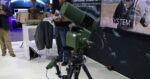
At DSEI 2025, MBDA presented an evolved concept that transforms Sea Venom into a broader family of guided munitions sharing common components but tailored for different mission sets. The modular approach centers on reusing critical subsystems—such as guidance electronics, seekers, warheads—across air-, sea-, and potentially ground-launched variants.
This evolution includes:
- Helicopter-launched variant: The baseline configuration remains optimized for naval helicopters like AW159 Wildcat or NH90 NFH.
- Surface-launch variant: A canisterized version suitable for deployment from unmanned surface vessels (USVs), patrol boats or even coastal batteries.
- Tactical land-strike variant: A conceptual adaptation aimed at ground vehicles or containerized launchers to engage high-value targets ashore.
The new variants retain key attributes such as low collateral effects and precision engagement capabilities but are adapted with different propulsion modules or launch interfaces depending on platform integration needs.
Design Rationale: Modularity Meets Operational Flexibility
The shift toward a modular architecture aligns with broader industry trends seen in programs like MBDA’s Enforcer NG or Lockheed Martin’s JAGM. By standardizing components across multiple delivery platforms while allowing tailored propulsion or control sections per variant, MBDA aims to reduce development costs while improving logistics efficiency.
This approach also supports NATO interoperability goals by enabling allied forces to field compatible munitions across diverse platforms—from manned helicopters to unmanned surface vessels (USVs) or mobile ground launchers. The ability to reconfigure payloads rapidly could also support emerging distributed lethality doctrines in both naval littoral operations and expeditionary land warfare.
Status of Integration with UK and French Forces
The original helicopter-launched Sea Venom is nearing full operational capability (FOC) with both UK Royal Navy Wildcat HMA Mk2s and French Navy Panther N3s. Flight trials have been conducted since at least 2017 under joint testing regimes. According to UK Defence Equipment & Support (DE&S), integration milestones were achieved throughout late 2023 into early 2024.
The new family variants are still in conceptual or early prototyping phases. No formal procurement decisions have been announced regarding surface-launch or land-strike versions; however, MBDA officials at DSEI indicated interest from several NATO navies exploring compact strike options deployable from USVs or containerized launchers aboard auxiliary ships.
Comparison With Related Systems: Martlet vs Brimstone vs Naval Strike Missile
The expanded Sea Venom family fills a niche between ultra-lightweight laser-guided rockets like Thales’ Martlet (Lightweight Multirole Missile) and heavier systems like Brimstone or Kongsberg’s Naval Strike Missile (NSM). Key differentiators include:
- Martlet: Lacks seeker autonomy; relies on laser designation; shorter range (~8 km).
- Brimstone: Heavier (~50 kg warhead); optimized for armored targets; more expensive per unit.
- Kongsberg NSM: Long-range (~185 km); too large/heavy for light helicopters; strategic-level weapon.
This positions Sea Venom as an intermediate solution offering greater range than Martlet but lower cost/logistics burden than Brimstone-class missiles—especially when deployed en masse aboard rotary-wing assets or small vessels operating in contested littorals.
Operational Implications: Littoral Warfare & Distributed Lethality
The modular evolution of Sea Venom supports emerging concepts of distributed maritime operations where smaller platforms—including USVs—can deliver precision fires without relying solely on major combatants. In congested littoral zones such as the Baltic Sea or Indo-Pacific archipelagos, this enables navies to saturate areas with credible strike options while minimizing risk exposure.
If land-based variants mature into deployable systems—potentially launched from JLTVs or containerized pallets—they could offer expeditionary forces an organic precision-fire capability without needing air support. This would be particularly relevant in grey zone conflicts where attribution control and scalable effects are critical considerations.
Outlook: From Conceptual Family to Fielded Capability?
No firm production timelines have been disclosed for the new variants beyond helicopter integration nearing completion. However, MBDA’s presentation at DSEI suggests growing interest among European defense planners in common-munition families adaptable across domains—a trend reinforced by budget constraints and evolving threat environments demanding rapid response tools deployable from diverse vectors.