France’s M51.3 Submarine-Launched Ballistic Missile Enters Operational Service
-
| Defense Industry & Geopolitics Observer

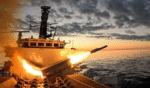
France has officially inducted the M51.3 submarine-launched ballistic missile (SLBM) into operational service with its strategic nuclear forces. The milestone marks a significant upgrade to the French Navy’s sea-based deterrent capability under the Force Océanique Stratégique (FOST), reinforcing the credibility of France’s nuclear triad amid evolving global threats.
M51.3 Enters Service After Successful Testing Campaign
The announcement by the French Ministry of Armed Forces on October 18, 2025 follows a successful final qualification test of the M51.3 in November 2023 from a submerged Triomphant-class SSBN off the coast of Brittany. The test validated both flight performance and system integration aboard current platforms.
The M51.3 is an evolutionary upgrade over its predecessor, the M51.2, with enhancements focused on extended range and improved penetration capabilities against modern missile defense systems. While official specifications remain classified, open-source estimates suggest a range increase from approximately 8,000 km (M51.2) to over 9,000 km for the M51.3 variant.
The program is managed by France’s Direction Générale de l’Armement (DGA), with ArianeGroup serving as prime contractor for development and production under contracts awarded since at least 2014. The new version is fully compatible with existing Triomphant-class SSBNs without requiring major structural modifications.
Strategic Role in France’s Nuclear Posture
The M51 SLBM family forms the backbone of France’s sea-based nuclear deterrent and one leg of its dyadic strategic posture—complemented by air-launched ASMPA-R cruise missiles carried by Rafale fighters of Strategic Air Forces (FAS) and Naval Aviation (FANu). France does not maintain land-based ICBMs.
Each Triomphant-class SSBN can carry up to sixteen M51 missiles equipped with multiple independently targetable reentry vehicles (MIRVs), believed to be TN75 or newer TNO warheads developed by CEA/DAM (Commissariat à l’énergie atomique et aux énergies alternatives / Direction des applications militaires). The exact number of warheads per missile remains undisclosed but is estimated at four to six per SLBM for strategic ambiguity.
With one SSBN continuously at sea under FOST command since the late Cold War era, France ensures second-strike capability even in worst-case scenarios—an essential pillar of its doctrine of “strict sufficiency” (dissuasion nucléaire).
Technical Enhancements Over Previous Variants
The transition from M45 to successive versions of the M51 reflects incremental modernization rather than radical redesigns—consistent with budgetary constraints and platform compatibility goals.
- M45: Entered service in late-1990s; range ~6,000 km; TN75 warheads
- M51: Introduced in early-2010s; larger diameter (~2.35 m), solid-fuel stages derived from Ariane space launchers
- M51.1/1A: Initial versions replacing M45 between ~2010–2016
- M51.2: Entered service ~2016; extended range (~8,000 km); improved guidance/penetration aids
- M51.3: Operational from late-2025; enhanced range (>9,000 km est.), upgraded avionics and countermeasures
The improvements are believed to include hardened electronics against counter-space threats and more sophisticated decoys or maneuverable reentry vehicles (MaRVs) aimed at defeating emerging ABM systems such as Aegis BMD or Russian S-500/S-550 complexes.
Sustainment Path Ahead: Toward SNLE-3G Integration
The induction of M51.3 also serves as a stepping stone toward future deployment aboard France’s next-generation third-generation SSBNs (SNLE-3G), expected to enter service starting in early-to-mid-2030s.
ArianeGroup has already been contracted for studies on further upgrades beyond M51.3—likely designated “M51.4”—to match evolving threat environments through mid-century timelines.
The SNLE-3G program was formally launched in February 2021 and will replace all four current Triomphant-class boats over a multi-decade horizon while maintaining continuous at-sea deterrence posture throughout transition phases.
Industrial Base and Strategic Autonomy Considerations
A key feature of France’s deterrence policy is full national control over design, production, and deployment—ensuring independence from foreign suppliers or alliances such as NATO when it comes to nuclear decision-making (“autonomie stratégique”).
- ArianeGroup: Prime contractor for SLBM design/manufacture; heritage from Ariane space boosters
- DGA: Program management and test oversight agency under MoD authority
- CEA/DAM: Warhead design/testing authority ensuring compatibility across platforms
- Naval Group: Builder of Triomphant-class SSBNs and future SNLE-3G hulls
- Saclay / Le Barp / Valduc sites: Core facilities supporting warhead R&D/simulation post-nuclear testing moratorium
This vertically integrated structure enables resilience against supply chain disruptions or export control restrictions—a contrast to multinational programs like Trident II D5 used by UK-US navies under shared arrangements.