LIG Nex1 Unveils Expanded Anti-Ship Missile Portfolio at ADEX 2025
-
| Defense Industry & Geopolitics Observer

At the Seoul International Aerospace & Defense Exhibition (ADEX) 2025, South Korea’s defense electronics giant LIG Nex1 showcased an expanded portfolio of anti-ship cruise missiles (ASCMs), reaffirming its position as a regional leader in precision-guided naval strike capabilities. The company presented three key systems: the operationally proven Haeseong-I (SSM-700K), the land-based variant of the longer-range Haeseong-II (SSM-710K), and a new family of compact ASCMs dubbed “Sea Sword.”
Haeseong-I (SSM-700K): South Korea’s Workhorse Naval Missile
The SSM-700K Haeseong-I is a subsonic sea-skimming cruise missile developed by LIG Nex1 in collaboration with South Korea’s Agency for Defense Development (ADD). It entered service with the Republic of Korea Navy (ROKN) in the mid-2000s and remains a cornerstone of South Korea’s shipborne anti-surface warfare capability.
Key specifications include:
- Range: ~150–180 km
- Speed: Subsonic (~Mach 0.85)
- Guidance: Inertial navigation system (INS) with terminal active radar homing
- Warhead: ~250 kg high-explosive fragmentation
The missile is launched from inclined canister launchers aboard major ROKN surface combatants such as KDX-class destroyers and Incheon-class frigates. It uses sea-skimming flight profiles to reduce radar cross-section and evade shipboard defenses.
The SSM-700K is often compared to Western analogues like Boeing’s Harpoon Block I or MBDA’s Exocet MM40 Block II. While not cutting-edge by global standards today, it remains reliable and forms the baseline for more advanced developments.
Haeseong-II (SSM-710K): Extended Reach for Land-Based Strike
A significant highlight at ADEX was the land-based version of the Haeseong-II (SSM-710K), which offers extended range and improved targeting capabilities over its predecessor. Originally developed for vertical launch from submarines or ships via K-VLS cells, this version adapts the missile to mobile coastal batteries akin to Russia’s Bastion-P or Norway’s NSM Coastal Defense System.
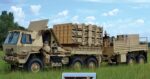
The land-based SSM-710K displayed at ADEX was mounted on an 8×8 wheeled transporter erector launcher (TEL), suggesting a focus on mobility and survivability in contested littoral environments. According to open sources and previous ADD disclosures:
- Estimated range: ~300–500 km
- Flight profile: High-subsonic cruise with terrain-following capability
- Sensors: Likely upgraded INS/GPS guidance with terminal radar seeker or EO/IR options
This configuration allows rapid redeployment along coastlines or islands—a critical factor given South Korea’s geostrategic need to deter naval incursions from North Korea or other regional actors.
The Sea Sword Family: Compact Missiles for Multi-Domain Use
LIG Nex1 also introduced a new line of lightweight anti-surface missiles under the brand name “Sea Sword.” These are designed for deployment across multiple platforms—surface vessels, helicopters, unmanned aerial vehicles (UAVs), and potentially even ground vehicles—filling a niche between full-size ASCMs like Haeseong and short-range guided rockets.
The Sea Sword series includes three variants based on launch platform compatibility:
- Sea Sword-I: For surface ships; uses box launcher configuration similar to MBDA Marte Mk2/N.
- Sea Sword-II: Air-launched variant optimized for rotary-wing platforms; likely intended for integration with ROKN AW159 Wildcat helicopters.
- Sea Sword-III: Under development; may be adapted for UAV carriage or coastal battery use.
No official performance figures were disclosed at ADEX, but industry representatives suggested ranges between 30–60 km depending on variant. Guidance modes are expected to include GPS-aided INS with imaging infrared (IIR) or millimeter-wave radar seekers in terminal phase—similar in concept to Lockheed Martin’s JAGM or MBDA’s Brimstone family.
Tactical Implications for ROK Navy Force Structure
The diversification of LIG Nex1’s ASCM offerings aligns closely with evolving Republic of Korea Navy doctrine emphasizing distributed lethality and layered maritime defense. The addition of mobile coastal batteries based on Haeseong-II enhances deterrence posture against amphibious threats near disputed maritime zones like the Northern Limit Line (NLL).
The Sea Sword series also opens doors to arming smaller vessels such as patrol boats or fast attack craft that previously lacked standoff strike capability. Furthermore, air-launched variants could significantly boost helicopter-borne anti-surface warfare reach without requiring large fixed-wing assets.
This modularity reflects global trends where navies seek scalable offensive options across manned/unmanned platforms while minimizing logistical burden through common architectures.
LIG Nex1’s Export Ambitions Amid Regional Competition
LIG Nex1 has been actively marketing its missile portfolio abroad under South Korea’s broader defense export strategy championed by DAPA. While flagship systems like K9 Thunder SPH have already found success globally, cruise missile exports remain limited due to MTCR constraints and stiff competition from established players like Raytheon/Kongsberg (NSM), MBDA (Exocet/Marte), or Russia’s Kalibr family.
The compact Sea Sword line may offer more export potential due to its lighter weight class—making it attractive for navies operating OPVs or corvettes without VLS infrastructure. Southeast Asia remains a likely target market given shared littoral security concerns and existing Korean defense ties with countries like Indonesia, Philippines, Thailand, and Malaysia.
ADEX Takeaways: Incremental Innovation over Disruption
LIG Nex1’s display at ADEX did not reveal revolutionary technologies but rather demonstrated steady evolution toward platform flexibility and indigenous capability growth. The company appears focused on maturing proven designs into modular families that can serve both domestic needs and export ambitions across multiple domains—from blue water operations to coastal denial missions.
This approach mirrors broader trends in modern naval warfare where survivability increasingly depends not only on sensor fusion but also on distributed offensive firepower across diverse platforms—including unmanned systems that may eventually carry future iterations of Sea Sword-type weapons.