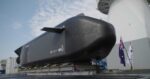
Inversion Space Unveils ‘Arc’ Reentry Vehicle for Orbital Logistics and Hypersonic Test Missions
-
| Defense Industry & Geopolitics Observer

California-based startup Inversion Space has unveiled its first operational vehicle design—dubbed “Arc”—a compact orbital reentry capsule intended to support both hypersonic testing and rapid cargo return from space. Designed with dual-use military and commercial applications in mind, the Arc vehicle is entering a competitive domain of responsive space logistics and reentry systems.
Arc Vehicle Overview: Compact Design for Strategic Utility
The Arc is a spherical reentry capsule measuring approximately 1.5 meters in diameter with an internal payload volume of about 400 liters—roughly the size of a large suitcase. The vehicle is designed to carry up to 150 kg of cargo or experimental payloads from orbit back to Earth with high precision.
Its small form factor allows it to be deployed as a secondary payload on existing launch vehicles such as Falcon 9 (SpaceX), Electron (Rocket Lab), or Vulcan Centaur (ULA). The capsule features ablative thermal protection for atmospheric reentry and deployable aerodynamic control surfaces for guided descent. Inversion claims that the Arc can achieve landing accuracy within tens of meters using GPS-aided navigation and onboard flight controls.
Military Applications: Hypersonic Testbed and Rapid Response Logistics
The U.S. Department of Defense has shown growing interest in small-scale orbital return vehicles like Arc due to their potential applications in hypersonic technology testing and time-sensitive logistics. Inversion has disclosed that it holds multiple contracts with DoD components—including AFWERX (U.S. Air Force innovation arm) and the Defense Innovation Unit (DIU)—to explore military use cases.
- Hypersonic testing: The Arc can serve as a low-cost platform to evaluate thermal protection systems (TPS), aerodynamic shapes, or guidance algorithms under realistic reentry conditions at Mach 20+ speeds.
- Responsive logistics: In scenarios such as battlefield resupply or emergency medical delivery, an orbital platform like Arc could deliver critical payloads globally within hours—bypassing contested airspace or denied access zones.
- Tactical ISR return: The system could retrieve sensor packages or surveillance data collected by LEO satellites without relying on downlink infrastructure vulnerable to jamming or interception.
This aligns with broader Pentagon efforts under programs like Rocket Cargo (USSF) and DARPA’s XS-1/XSP initiatives aimed at enabling rapid point-to-point delivery via space-based systems.
Commercial Use Cases: Biotech, Semiconductor & Microgravity Research
Beyond defense applications, Inversion is positioning the Arc vehicle as a commercial service platform for industries requiring microgravity exposure followed by rapid sample return. This includes:
- Pharmaceutical R&D: Drug crystallization studies in microgravity environments can yield purer compounds; quick return enables time-sensitive analysis.
- Advanced materials: Semiconductor wafers grown in orbit may benefit from defect-free structures; returning them intact is critical for validation.
- Cubesat recovery: Small satellite developers may use Arc to retrieve flight hardware post-mission for reuse or forensic analysis.
The company envisions a future where dozens of such capsules operate in orbit as part of an on-demand cargo network linking Earth’s surface with low Earth orbit labs, platforms like Axiom Station or Starlab, or even lunar gateway nodes in extended versions.
Status Update: Ground Testing Underway Ahead of First Launch
As of Q4 FY2025, Inversion reports that the first full-scale prototype of the Arc has completed structural qualification tests including vibration profiles simulating launch loads. Thermal vacuum chamber trials are ongoing at NASA facilities under a CRADA agreement (Cooperative Research and Development Agreement).
The maiden orbital flight is scheduled no earlier than mid-2026 aboard a rideshare mission coordinated through Spaceflight Inc., likely deploying into a sun-synchronous orbit (~500 km altitude). Recovery will be attempted via parachute-assisted splashdown off California’s coast using autonomous marine vessels operated by partner startup Ocean Aero.
A Crowded Field: Competing Concepts from Varda Space & Sierra Space
The market for orbital return capsules is rapidly heating up. Varda Space Industries launched its first capsule aboard Rocket Lab’s Photon bus in June 2023 but faced delays due to FAA licensing issues before finally recovering it successfully in early 2024. Their system targets pharmaceutical manufacturing returns from microgravity labs aboard commercial spacecraft modules.
Sierra Space’s Dream Chaser—a winged lifting body—offers higher payload capacity (~1,750 kg) but at significantly greater cost and complexity than ballistic capsules like Arc. Other players include D-Orbit (Italy) exploring modular return pods and Japan’s JAXA-backed HTV-XR project aimed at automated sample retrieval missions post-ISS deorbiting era.
Strategic Implications: Enabling Responsive Access-to-Orbit-and-Back
If successful, systems like Inversion’s Arc could reshape how militaries approach time-critical missions involving space assets—not just launching into orbit but also retrieving hardware/data rapidly when needed. For defense planners focused on resilience under anti-access/area-denial (A2/AD) conditions—or adversaries targeting satellite constellations—the ability to recover key assets offers strategic flexibility previously unavailable outside crewed missions.
This also dovetails with emerging concepts around “space mobility” where platforms may dock with satellites for servicing/refueling or repositioning—requiring robust terminal guidance capabilities akin to those being developed within the Arc program today.