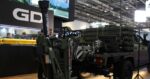
IDV Unveils Viking UGV at DSEI 2025: Hybrid-Powered Autonomy for Tactical Ground Operations
-
| Military Robotics & AI Analyst

At DSEI 2025 in London, Italian defense manufacturer IDV (Iveco Defence Vehicles) officially unveiled the Viking uncrewed ground vehicle (UGV), a modular robotic platform designed to provide logistical and tactical support across a range of battlefield environments. With hybrid-electric propulsion and scalable autonomy at its core, the Viking reflects growing European investment in robotic systems for contested logistics and force multiplication.
Modular Design for Multi-Mission Flexibility
The Viking UGV is built on a modular chassis that supports multiple mission payloads. At its core is a flatbed architecture capable of transporting up to 750 kg of cargo — including ammunition resupply packs, sensor payloads, or casualty evacuation stretchers. IDV showcased several configurations at DSEI 2025:
- Logistics mode with cargo racks
- ISR variant equipped with mast-mounted EO/IR sensors
- Weaponized version featuring a remote weapon station (RWS)
The platform’s open architecture allows integration of NATO-standard interfaces and third-party modules. It is designed to be air-transportable by CH-47 or NH90-class helicopters and can be deployed from tactical vehicles such as the Iveco LMV.
Hybrid-Electric Propulsion Enhances Stealth and Endurance
A key differentiator of the Viking is its hybrid-electric powertrain. The system combines a diesel generator with electric drive motors powering all four wheels independently. This configuration enables silent operation in electric-only mode for short-range stealth missions — particularly valuable in ISR or special operations contexts.
IDV claims an operational endurance of up to 8 hours in mixed-mode use and up to 3 hours in silent electric mode. The onboard generator can recharge the battery while stationary or during movement. The vehicle’s top speed is reported at approximately 40 km/h on-road and around 20 km/h cross-country.
Autonomy Stack Supports Semi-Autonomous Convoying and Waypoint Navigation
The Viking incorporates an autonomy suite developed in collaboration with Leonardo’s robotics division. While not fully autonomous under all conditions, it supports several key capabilities:
- Waypoint-based navigation via GPS/GNSS
- Obstacle detection using LiDAR and stereo vision
- Semi-autonomous convoying behind manned vehicles
A remote operator can supervise multiple Vikings via secure RF or SATCOM links using a ruggedized tablet interface. The autonomy stack complies with STANAG standards for interoperability within NATO formations.
Tactical Roles from Logistics to Force Protection
IDV positions the Viking as a multi-role enabler for dismounted infantry units operating beyond secure supply lines. Its primary roles include:
- Tactical logistics: Ammunition resupply over last-mile terrain inaccessible by larger vehicles.
- Casualty evacuation: Transporting wounded personnel under fire without risking additional troops.
- ISR support: Providing persistent surveillance via mast-mounted EO/IR payloads.
- Force protection: Armed variants can serve as perimeter sentries or mobile fire support nodes.
The system has undergone limited field trials with Italian Army light infantry units since early 2024 under the Robotic Autonomous Systems (RAS) experimentation program led by Segredifesa (Italian MoD’s procurement agency).
IDV’s Broader Robotics Strategy and Market Outlook
The introduction of the Viking aligns with IDV’s broader push into manned-unmanned teaming (MUM-T) concepts across land platforms. It complements other developments such as optionally crewed variants of the Centauro II wheeled tank destroyer family and digitalized logistics vehicles under Project VTL (Veicolo Tattico Logistico).
IDV aims to position the Viking not only for domestic adoption but also for export markets across NATO-aligned countries seeking affordable robotic enablers that integrate seamlessly into existing C4ISR architectures. While no production contracts have been announced as of September 2025, discussions are reportedly underway with several European armed forces following demonstrations at DSEI.
Challenges Ahead: Autonomy Maturity and Battlefield Integration
The Viking faces typical hurdles encountered by emerging UGV platforms — namely maturing its autonomy stack beyond structured environments and ensuring robust comms resilience under EW threat conditions. Additionally, doctrine integration remains nascent; many armies are still developing TTPs (tactics, techniques & procedures) for employing UGVs effectively alongside manned elements without increasing cognitive load on dismounted troops.
IDV has indicated plans to conduct multinational trials through NATO’s DIANA initiative in late 2026 focused on interoperability testing within combined arms formations operating under contested electromagnetic conditions.
Outlook: A Scalable Entrant into Europe’s Expanding UGV Ecosystem
The debut of the Viking at DSEI underscores Europe’s accelerating investment in ground robotics amid lessons learned from Ukraine regarding attrition warfare logistics and forward-deployed ISR needs. While still pre-production, IDV’s offering enters an increasingly competitive space alongside Milrem Robotics’ THeMIS series, Rheinmetall’s Mission Master family, and KNDS’s upcoming ARX30-based UGV concept.
If successfully integrated into force structures through iterative testing cycles over the next two years, the Viking could become a viable mid-weight solution bridging gap between lightweight RAS drones and heavier autonomous combat platforms like Rheinmetall’s Wiesel-based WARAthena demonstrator.