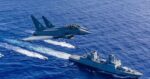
South Korea’s FA-50 Fighter Upgrades with Raytheon PhantomStrike AESA Radar
-
| Aerospace & UAV Researcher

South Korea’s FA-50 light combat aircraft has received a major sensor upgrade with the integration of Raytheon’s PhantomStrike active electronically scanned array (AESA) radar. This marks a significant boost in the aircraft’s situational awareness and targeting capabilities, enhancing its competitiveness in both domestic service and export markets.
PhantomStrike: A Compact AESA Designed for Lightweight Fighters
The PhantomStrike radar is part of Raytheon’s next-generation compact AESA product line. It is designed specifically for light fighter platforms such as the FA-50 and F-5 modernization programs. Unlike legacy mechanically-scanned arrays or hybrid passive systems, PhantomStrike offers full solid-state AESA performance in a low size, weight, and power (SWaP) package.
Key features include:
- Gallium Nitride (GaN)-based transmit/receive modules for higher output power and thermal efficiency
- Multi-mode operation supporting air-to-air and air-to-ground missions
- Synthetic aperture radar (SAR) imaging and ground moving target indication (GMTI)
- Track While Scan (TWS), Beyond Visual Range (BVR) engagement support
The system is fully software-defined and supports open architecture standards. According to Raytheon executives cited in multiple defense outlets including Breaking Defense and Janes Defence Weekly (2023–2024), the radar can be integrated without requiring major airframe modifications—critical for aircraft like the FA-50 that have limited space in their nose cones.
FA-50 Golden Eagle: From Trainer to Multirole Combat Platform
The FA-50 is a combat-capable variant of the T-50 Golden Eagle advanced jet trainer developed by Korea Aerospace Industries (KAI) in partnership with Lockheed Martin. Originally conceived as a lead-in fighter trainer (LIFT), the FA-50 has evolved into a lightweight multirole platform capable of precision strike, close air support (CAS), interception, and limited beyond visual range engagements.
Key specifications include:
- Maximum speed: Mach 1.5
- Combat radius: ~1,800 km with drop tanks
- Weapons compatibility: AIM-9 Sidewinder, AGM-65 Maverick, JDAMs/LGBs
- Radar prior to upgrade: EL/M-2032 mechanically scanned array or variants thereof
The integration of PhantomStrike replaces older mechanically scanned radars on newer production blocks of the FA-50 or retrofitted models under customer-specific configurations. This significantly enhances detection range—potentially doubling it depending on target RCS—and allows simultaneous tracking of multiple targets even in cluttered environments.
Export Implications: Boosting Global Appeal of the FA-50 Lineup
The addition of an advanced AESA radar makes the FA-50 more competitive against rivals like India’s Tejas Mk1A or Pakistan/China’s JF-17 Block III. Several recent export deals underscore this trend:
- Poland: Ordered 48 FA-50s in two tranches; deliveries began in mid–2023; Block II variants expected to feature PhantomStrike from factory.
- Malaysia: Selected the FA-50 over Tejas for its Light Combat Aircraft program; contract signed February 2023.
- Philippines: Operates earlier versions; potential upgrades under discussion.
KAI has also been marketing upgraded variants such as the “FA–50PL” for Poland with conformal fuel tanks (CFTs), aerial refueling probe capability, Sniper targeting pod integration—and now confirmed inclusion of PhantomStrike radar. These enhancements position the platform closer to full-fledged multirole fighters while retaining its affordability advantage.
Tactical Impact: Enhanced Situational Awareness & BVR Capability
The move from mechanical scanning to AESA fundamentally changes how an aircraft can operate tactically. With PhantomStrike onboard:
- Pilot workload is reduced through automated multi-target tracking and prioritization algorithms.
- Beyond Visual Range missile employment becomes viable due to improved detection/tracking fidelity at long ranges.
- SAR/GMTI modes enable precision strike even under degraded visual conditions or GPS-denied environments.
This aligns with evolving South Korean Air Force doctrine emphasizing network-centric warfare and interoperability with U.S./NATO-standard systems. The radar also supports Link–16 data sharing protocols—critical for joint operations across domains.
AESA Radar Proliferation Among Light Fighters
The introduction of compact AESAs like PhantomStrike reflects a broader trend toward high-end sensor proliferation among lower-tier platforms. Comparable developments include:
- I-Derby ER-equipped Tejas Mk1A: Uses EL/M–2052 AESA from Elta Systems.
- JF–17 Block III: Incorporates Chinese KLJ–7A AESA system with similar BVR capabilities.
- Boeing-Saab T–7 Red Hawk: Expected to receive advanced sensors if armed variants are fielded post-U.S. Air Force training role entry.
This capability migration blurs traditional distinctions between “trainer,” “light attack,” and “fighter” categories—especially when paired with modern datalinks, EW suites, smart munitions, and AI-enabled mission computers. For countries unable to afford F–16Vs or Gripen Es at scale but still requiring credible deterrence or expeditionary capacity under budget constraints—the upgraded FA–50 presents an increasingly attractive option.
KAI-Raytheon Partnership Outlook & Future Roadmap
Korea Aerospace Industries has been working closely with Raytheon Technologies on phased upgrades across its T/FA–50 family since at least early 2020s. In addition to sensors like PhantomStrike, other areas under development include electronic warfare self-protection suites based on ALQ-series pods and integration of longer-range standoff weapons such as SLAM–ER or Taurus KEPD350 derivatives pending structural certification.
KAI aims to deliver over 200 new-build T/FA–50s globally by early 2030s—with many configured at Block II+ level incorporating these enhancements out-of-the-box rather than via retrofit pathways. The Republic of Korea Air Force is also considering using upgraded T/FA–50s as part of homeland defense augmentation alongside KF–21 Boramae stealth fighters currently entering serial production testing phase as of late 2024/early 2025.