F-15EX: The Eagle II Becomes the Sky’s Battle Manager in MUM-T and JADC2
-
| Defense Systems Analyst
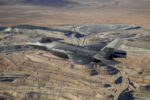
The U.S. Air Force’s newest fighter, the Boeing F-15EX Eagle II, isn’t just another patched-up Eagle—it represents a transformational re-invention of the F-15 lineage. As revealed in exclusive analysis by Army Recognition, the F-15EX is no longer defined by its speed or weapons load alone—it’s poised to become a command-and-control node in the sky, centralized for manned-unmanned teaming (MUM-T) and Joint All-Domain Command and Control (JADC2). ([turn1view0]).
With dual crew stations, cutting-edge avionics, and an open mission architecture, the F-15EX is engineered for a future where fights are won through networked data and drone coordination as much as dogfights.
1. The Legacy of the Eagle: Now with a Smarter Cockpit
Emerging from the venerable F-15 series—first introduced in the 1970s as a pure air superiority fighter—the F-15EX builds on decades of evolution:
-
F-15C/D: Advanced radar and avionics, legacy air defense workhorse
-
F-15E Strike Eagle: Added deep strike capability and a second crewmember
-
F-15SA/QA (Advanced Eagle): Upgraded airframes, new digital backbones, structural life extension to 20,000 hours
-
F-15EX (Eagle II): Operational since July 2024, replacing the aging F-15C/D inventory, now enhanced with Command-and-Control and MUM-T roles. ([turn0search20]).
By embracing digital cockpits, fly-by-wire, and AESA radars, the Eagle II is both a fighter and a node in the JADC2 grid.
2. Manned-Unmanned Teaming: The F-15EX on the MUM-T Frontier
Why F-15EX is Uniquely Suited to MUM-T
-
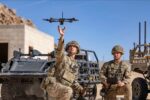
Two-seat cockpit: One pilot handles flying, the second manages unmanned combat aircraft (“loyal wingmen”) or sensors. ([turn0search2], [turn0search15])
-
Large-area displays: Crew can process big data and orchestrate complex missions with situational clarity. ([turn1view0])
-
Open mission architecture: Allows rapid software upgrades and integration of new systems and weaponry. ([turn0search2])
-
Communication suite: Designed to operate beyond line-of-sight—key for controlling dispersed drone swarms. ([turn0search2])
The Conceptual Role
Once relegated to AWACS or ground-based command, that role now flies. The F-15EX:
-
Manages and orchestrates CCAs/loyal wingmen
-
Acts as the airborne battle manager in contested airspace
-
Enables distributed mission command, not tethered to static nodes vulnerable to jamming or destruction. ([turn1view0], [turn0search15])
This architecturally transforms the fighter from a solo hunter into a team conductor.
3. Fighting Through Networked Warfare: JADC2 and Beyond
JADC2 doctrine emphasizes dispersal, resiliency, and speed of decision-making across air, land, sea, cyber, and space domains. The F-15EX is built for this paradigm:
-
Flexible sensor fusion and mission computing
-
Serves as a command node alongside F-35s, B-21s, and CCA swarms
-
Bridges stealth and mass: stealth jets go deep, F-15EX stays networked and loaded, directing from safer vectors. ([turn1view0])
4. Technical Strengths & Payload Capacity
-
Powerplant: F110-GE-129 engines deliver exceptional thrust-to-weight ratio
-
Payload: Spools up to 29,500 lb—the highest of any USAF fighter. ([turn0search1])
-
Sensors & Survivability: AESA radar, EPAWSS EW suite, IRST pod (Legion/IRST21), 20,000-hour life airframe. ([turn0search20])
-
Flexibility: Can carry standoff weapons, precision strike munitions, or act entirely as network commander. ([turn0search20])
5. Strategic Logic in High-End Competition
Against Russia and China, U.S. air strategy embraces:
-
Distributed control to overcome EW and cyber disruption
-
Persistent loiter and overmatch, coordinated via MUM-T as mass power
-
Low-cost attritable assets commanded by a centralized, resilient node (F-15EX).
It’s not about stealth alone—it’s about cohesion and control within a contested, chaotic battlespace. ([turn1view0], [turn0search9])
6. Organizational Impact & Alliance Appeal
Program status:
-
Initial operational capability declared mid-2024
-
Planned fleet: ~129 jets, with $3B budget in FY26. ([turn0search14])
Global adoption potential:
-
Countries like Israel, Qatar, Saudi Arabia, Japan already fly variants—interoperability is seamless. ([turn1view0], [turn0search20])
-
Poland, Thailand are interested in F-15EX options—adding MUM-T gives extra sell strength. ([turn0search20])
7. Critical Considerations
-
Survivability concerns in high-A2/AD environments still favor stealth aircraft for low observability.
-
Data link security and EM spectrum robustness—MUM-T depends on jam-resistant comms.
-
Operational training for new doctrine: crew orchestration, drone management, manned-unmanned tasking.
-
Budget balance: Ensuring production funding doesn’t undercut NGAD or F-35 sustainment.
8. Conclusion: The Eagle II Is the Sky’s Referee
The F-15EX isn’t just an improved fighter—it’s a networked battle manager enabling massed, coordinated effects in the air, sea, land, and cyber domains. Its payload, cockpit, and architecture make it a critical interim asset as the Air Force transitions toward fully integrated, autonomous future warfighting.
With F-15EX, USAF is not just ensuring air superiority but securing the ability to orchestrate the 21st-century aerial battlespace in real time.

Defense Systems Analyst
F-15EX Eagle II: The Fighting Brain of Future Airpower
The F-15EX is evolving from a fourth-gen fighter into a digital-age command node. With its two-seat design, open architecture, and heavy payload, it’s uniquely poised to quarterback MUM-T and support JADC2.
4.5 / 5
Pros
- Unmatched payload and mission flexibility
- Modular upgrades and long service life
- Premier node for drone coordination and joint C2
- Affordable bridge between legacy systems and next-gen platforms
Cons
- Not stealthy—vulnerable in heavily saturated airspace
- Requires robust net-centric integration and anti-jam systems
- Crew training and operational doctrine must catch up