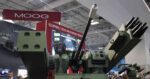
Destinus Unveils Hornet Interceptor System to Counter Drone Swarms at DSEI 2025
-
| Defense Systems Analyst

At DSEI 2025 in London, Swiss aerospace firm Destinus revealed its concept for the “Hornet” interceptor system—an AI-enabled counter-unmanned aerial system (C-UAS) platform designed to neutralize drone swarms and low-cost loitering munitions. As drone saturation tactics proliferate across modern battlefields, the Hornet aims to provide a cost-effective and scalable solution for short-range air defense (SHORAD).
Hornet Concept Overview: A New Layer in SHORAD
The Destinus Hornet is conceived as a kinetic interceptor platform optimized for engaging Class I and II drones—typically quadcopters and fixed-wing UAVs under 150 kg. The system is modular and scalable, intended to be deployed in clusters or batteries around critical infrastructure or forward operating bases.
According to Destinus representatives at DSEI 2025, the Hornet combines autonomous target detection with high-speed interceptors guided by onboard AI. The architecture is designed to minimize human-in-the-loop latency while retaining operator override capability. Key features include:
- Autonomous threat classification using onboard sensors and neural networks
- High agility kinetic interceptors with active guidance
- Modular launch pods, potentially truck- or container-mounted
- C4ISR integration via NATO-standard data links (e.g., Link-16)
The system is not yet fielded but has reportedly completed early-stage design validation and simulation testing. Live-fire trials are expected in late 2026.
Design Philosophy: Cost-per-Kill vs Threat Saturation
The proliferation of low-cost drones—ranging from $500 FPVs to $20k loitering munitions—has created an asymmetric challenge for traditional air defense systems. Using $1 million SAMs against $500 drones is economically unsustainable. Destinus positions the Hornet as a response to this cost-per-kill imbalance.
The company claims that each Hornet interceptor round would cost under $25,000—a fraction of the price of traditional surface-to-air missiles but more capable than soft-kill options like jamming alone. The use of AI-driven target prioritization allows the system to dynamically allocate interceptors based on threat behavior (e.g., loitering vs terminal dive), optimizing resource usage.
Sensors and Guidance: Fusing Autonomy with Precision
The Hornet’s kill chain begins with multi-spectral sensors mounted on each launcher module or integrated into a central sensor mast. These likely include:
- EO/IR cameras for visual tracking in day/night conditions
- X-band AESA radar (under development) for small target acquisition in cluttered environments
- Passive RF detection modules for identifying drone control links or GNSS emissions
Sensors feed into an onboard processing unit running proprietary neural network algorithms trained on thousands of drone signatures. Once classified as hostile, a kinetic interceptor is launched using cold-gas ejection followed by rocket motor ignition.
The interceptor itself is believed to use thrust-vector control (TVC) or canard-based maneuvering with terminal guidance via active radar homing or EO seeker heads. While exact specifications remain undisclosed, Destinus emphasizes high-G maneuverability sufficient to engage agile FPV drones executing evasive patterns.
C-UAS Market Context and Competitive Landscape
The global C-UAS market has seen explosive growth since Russia’s invasion of Ukraine highlighted the battlefield impact of cheap drones. Systems like Rheinmetall’s Skynex, Israel’s Iron Beam (laser), Anduril’s Lattice OS + Anvil interceptors, and Leonardo’s Falcon Shield dominate different niches—from soft-kill EW suites to hard-kill kinetic launchers.
The Hornet enters this space aiming for a middle ground between affordability and lethality. Unlike directed energy systems—which require significant power infrastructure—or net-based capture systems ill-suited for swarms, the Hornet proposes a self-contained kinetic solution deployable without heavy logistics footprint.
If successfully developed and proven in trials by late 2026–27 as planned, it could appeal to NATO forces seeking affordable SHORAD augmentation or nations facing asymmetric UAV threats without access to top-tier missile defenses.
Status and Roadmap Ahead
No production contracts have yet been announced for the Hornet system as of September 2025. However, Destinus confirmed it has secured initial R&D funding from Swiss innovation agencies and private investors focused on dual-use aerospace technologies.
The company plans the following milestones:
- Q4 2025: Hardware-in-the-loop simulation testing begins at test range in Switzerland.
- Mid-2026: First live-fire trials using surrogate drones; validation of sensor-to-interceptor loop latency.
- Late-2026: System-level demo with multiple launchers engaging coordinated swarm scenario.
- EoY 2027: Potential limited production run pending customer interest; NATO interoperability certification process begins if pursued by member state partner(s).
An open question remains whether Destinus will seek collaboration with established defense primes for integration into existing IADS architectures—or pursue direct sales targeting smaller militaries or critical infrastructure protection markets such as airports or energy facilities.