Chinese J-15 Fighter Jets Simulate Strike on UK Carrier Strike Group in South China Sea
-
| Defense Industry & Geopolitics Observer

In a high-stakes demonstration of power projection and anti-access/area denial (A2/AD) capabilities, Chinese People’s Liberation Army Navy (PLAN) J-15 carrier-based fighter jets reportedly simulated “constructive kills” against the British Royal Navy’s HMS Queen Elizabeth Carrier Strike Group (CSG) during its recent transit through the South China Sea. The incident underscores intensifying maritime tensions and evolving air-sea integration tactics in one of the world’s most contested strategic regions.
Simulated Engagements Reflect Escalating Maritime Posturing
According to multiple defense sources including open-source intelligence analysts and regional military observers, the simulated attack occurred as part of a broader pattern of PLAN assertiveness around key maritime chokepoints. During the encounter—believed to have taken place in international waters but within China’s self-declared Air Defense Identification Zone (ADIZ)—several Shenyang J-15 multirole fighters launched from the aircraft carrier Liaoning or land-based airfields reportedly approached within radar range of the UK CSG.
The term “constructive kill” refers to a simulated engagement where targeting parameters are met—such as radar lock-on or missile envelope entry—even if no live munitions are fired. In this case, Chinese pilots reportedly executed mock firing solutions against key assets including HMS Queen Elizabeth and its escort vessels such as HMS Defender (Type 45 destroyer) and HMS Kent (Type 23 frigate).
While no weapons were discharged and no breach of international law confirmed by either side, British officials described the incident as “unprofessional” and “escalatory.” The UK Ministry of Defence has not officially released detailed accounts but acknowledged that “interactions with foreign military aircraft were monitored throughout.”
J-15 Capabilities and Tactical Implications
The Shenyang J-15—NATO reporting name “Flanker-X2″—is derived from Russia’s Su-33 design but indigenized with Chinese avionics and weapon systems. It is currently China’s only operational carrier-borne fixed-wing fighter deployed aboard Liaoning and Shandong carriers. Despite limitations such as heavy airframe weight and reliance on ski-jump launches rather than catapults (CATOBAR), recent upgrades have improved its combat radius (~1,200 km), radar performance (likely AESA variants), and compatibility with PL-series air-to-air missiles.
- Primary armament: PL-12 medium-range AAMs; PL-8 short-range IR-guided missiles; YJ-series anti-ship missiles for strike roles
- Sensor suite: Improved fire-control radar; possible integration with datalinks for cooperative targeting
- Tactical role: Fleet defense interceptor; maritime strike; electronic support missions
The simulated strike suggests PLAN pilots are training for saturation attacks against high-value naval targets using coordinated wave tactics. This aligns with broader PLA doctrine emphasizing asymmetric denial strategies against Western naval forces operating near China’s periphery.
Royal Navy Response and Carrier Group Composition
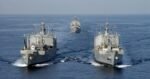
The UK’s Carrier Strike Group deployment was part of Indo-Pacific outreach efforts under “Global Britain” defense posture realignment. Led by HMS Queen Elizabeth—a modern STOVL carrier operating F-35B Lightning IIs—the task force included:
- HMS Defender: Type 45 destroyer with advanced Sampson radar & Sea Viper SAM system
- HMS Kent: Type 23 frigate optimized for ASW operations
- A Royal Fleet Auxiliary tanker & logistics ship
- A U.S. Arleigh Burke-class destroyer embedded for interoperability
- A Dutch De Zeven Provinciën-class frigate contributing IAMD capabilities
The CSG’s F-35Bs likely detected incoming J-15s via their AN/APG-81 AESA radars well before visual range. However, rules of engagement in peacetime restrict kinetic responses unless hostile intent is demonstrated unequivocally. Instead, RAF pilots aboard F-35Bs may have shadowed or intercepted PLAN aircraft while maintaining deconfliction protocols.
Tactical Signaling or Strategic Messaging?
This episode fits into an emerging pattern where Chinese forces use close encounters to test adversary responses while signaling resolve over territorial claims—particularly around Taiwan Strait and Spratly Islands. By simulating attacks without crossing red lines that would justify retaliation, Beijing engages in “gray zone” coercion designed to normalize its military presence.
The timing coincided with joint exercises between ASEAN partners and Western navies in nearby waters—further amplifying Beijing’s message that it views foreign naval presence near its claimed territories as provocations. Analysts also note that these simulations help refine PLAN joint targeting procedures involving ISR platforms like KJ-500 AEW&C aircraft or YJ-series missile-equipped bombers operating alongside fighters.
Escalation Risks Amidst Growing A2/AD Architecture
The incident highlights how close-proximity maneuvers involving advanced platforms risk rapid escalation due to miscalculation or miscommunication. China’s expanding A2/AD network—including DF-21D/DF-26 anti-carrier ballistic missiles (ACBMs), long-range SAMs like HQ-9B/HQ-22, coastal cruise missile batteries, EW systems like Type 055 DDG jammers—creates a layered threat environment for any surface group operating within First Island Chain.
NATO navies must now factor electronic warfare spoofing attempts, GNSS jamming/spoofing events (as seen near Taiwan), cyber probing of shipboard networks during transits—all part of an integrated deterrence strategy by Beijing leveraging both kinetic and nonkinetic tools.