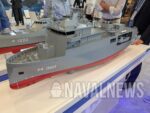
Mysterious Black Trimaran Drone Ship Emerges at Chinese Shipyard
-
| Aerospace & UAV Researcher

A striking black trimaran unmanned surface vessel (USV) has been spotted at the Jiangsu Dayang Marine shipyard in China. The vessel’s unconventional design—featuring a low-observable hull form and no visible crew facilities—suggests it could be part of an emerging class of large autonomous naval platforms under development by the People’s Liberation Army Navy (PLAN). This sighting adds to growing evidence of China’s rapid expansion into unmanned maritime warfare.
Stealthy Trimaran Design Raises Eyebrows
Imagery captured in late September 2025 shows a sleek black trimaran hull berthed at the Jiangsu Dayang shipyard. The vessel appears to be approximately 20–25 meters long and features a distinctive wave-piercing central hull flanked by narrow outriggers. Most notably, it lacks any obvious bridge or crew accommodations—strongly indicating an unmanned configuration.
The black coloration and angular surfaces suggest radar cross-section (RCS) reduction measures consistent with stealth design principles. The trimaran form provides enhanced stability and deck space while minimizing hydrodynamic drag—a configuration previously adopted by US Navy vessels like the Sea Hunter USV developed under DARPA’s ACTUV program.
Naval analysts have speculated that this new Chinese platform may serve as a testbed for autonomous navigation systems, distributed sensor networks, or even offensive payload delivery in contested maritime environments. Its emergence signals that China is not only catching up with Western USV programs but may be exploring unique operational concepts tailored to its regional strategic needs.
Part of a Broader PLAN Unmanned Naval Push
The appearance of this drone ship aligns with several recent developments pointing to an aggressive push by the PLAN into unmanned naval warfare. Over the past three years, China has unveiled multiple classes of USVs—from small interceptors to medium-sized ISR craft like the JARI-USV—to support surveillance, mine countermeasures (MCM), electronic warfare (EW), and potentially strike missions.
In 2023 and 2024, satellite imagery revealed suspected testing areas for autonomous naval systems near Sanya Naval Base on Hainan Island and on the Bohai Sea coast. These test zones featured moored targets and support vessels consistent with swarm coordination trials or remote control exercises.
China’s 14th Five-Year Plan explicitly highlights intelligentized warfare—including autonomous systems—as a key modernization priority for the PLA. The PLAN’s embrace of AI-enabled platforms reflects its desire to offset U.S. naval dominance through asymmetric capabilities such as drone swarms and distributed maritime ISR networks.
Potential Missions: ISR Node or Lethal Strike Asset?
The exact role of the new trimaran remains unclear due to limited open-source data—but several plausible mission sets emerge based on its design characteristics:
- ISR Platform: With ample deck space and presumed onboard power generation capacity, it could host EO/IR sensors, AESA radar arrays, or passive ELINT gear for persistent maritime surveillance without risking human crews.
- C2 Relay Node: In distributed operations or denied environments (e.g., GPS-jammed zones), such vessels could act as communications relays between manned ships and UAVs/USVs operating over-the-horizon.
- Lethal Strike Platform: If fitted with vertical launch cells or containerized missile pods—as seen on other Chinese USVs—it might serve as a low-profile strike asset capable of launching anti-ship missiles (AShMs) or loitering munitions.
The modularity suggested by its open deck plan would allow rapid reconfiguration between roles—mirroring trends seen in Western navies’ experimentation with multi-mission USVs like MARTAC’s MANTAS T38 or Israel’s BlueWhale platform.
Industrial Clues Point to Advanced Development Stage
The Jiangsu Dayang Marine shipyard is no stranger to advanced naval construction projects. Located near Yancheng on China’s east coast, it has previously built vessels for both civilian use and military purposes—including catamarans used by China’s Coast Guard and research institutions tied to defense R&D programs.
The presence of this new trimaran alongside other completed hulls suggests it is not merely a prototype mock-up but part of an active production cycle—possibly indicating serial development of similar platforms. Moreover, refinements visible in satellite imagery between July–September 2025 show progressive outfitting activity consistent with final integration phases before sea trials.
This timeline implies that the platform may enter testing within Q1–Q2 2026 if not already underway covertly under PLAN oversight or via dual-use civilian-military partnerships common in China’s defense-industrial ecosystem.
Strategic Implications for Indo-Pacific Maritime Balance
If confirmed as an operationally viable USV class, this stealthy black trimaran could significantly enhance China’s ability to conduct persistent surveillance across chokepoints like the Taiwan Strait or South China Sea without risking manned assets. In wartime scenarios, swarms of such vessels could saturate adversary defenses through distributed attacks while complicating targeting decisions due to their low RCS profiles.
This development also raises concerns about escalation dynamics involving unmanned platforms operating autonomously near contested waters. As navies struggle with rules-of-engagement protocols for drones lacking onboard crews—and potentially operating under AI-driven autonomy—the risk of miscalculation increases significantly.
Nations such as Japan, Australia, and India may need to accelerate their own USV programs—or deepen cooperation with U.S.-led initiatives like Ghost Fleet Overlord—to maintain parity in emerging undersea-autonomous domains where manned presence is increasingly risky or unsustainable over time.
A Glimpse Into Future Naval Warfare
The emergence of this mysterious black trimaran drone underscores how rapidly naval warfare is evolving toward autonomy-driven concepts leveraging stealthy platforms and networked operations. While details remain scarce about its sensors or payloads, its very existence signals that China is moving beyond small experimental drones toward larger-scale unmanned surface combatants capable of independent action across blue-water theaters.
This vessel may soon join others already undergoing testing along China’s coasts—forming part of a broader shift toward intelligentized maritime operations where human operators coordinate from afar while machines patrol forward lines autonomously. Whether used for ISR collection or kinetic effect delivery remains uncertain—but what is clear is that global navies must now contend with increasingly sophisticated robotic fleets emerging from Chinese yards at pace—and likely scale—in years ahead.