China Tests DF-26D Hypersonic Missile: A New Threat to U.S. Bases in the Pacific
-
| Defense Systems Analyst

China has reportedly conducted a test launch of the DF-26D missile—a new hypersonic-capable variant of its infamous “Guam Killer” intermediate-range ballistic missile (IRBM). The development signals a significant leap in China’s anti-access/area denial (A2/AD) posture across the Indo-Pacific and raises concerns over the survivability of forward-deployed U.S. assets.
DF-26 Evolution: From Dual-Capable IRBM to Hypersonic Variant
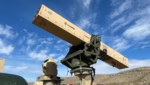
The original DF-26 (Dong Feng-26) is a road-mobile IRBM with an estimated range of 4,000 km. First unveiled in 2015 and inducted into service with the People’s Liberation Army Rocket Force (PLARF) around 2016–2018, it is capable of delivering either conventional or nuclear warheads. The missile earned the nickname “Guam Killer” due to its ability to strike U.S. military installations on Guam from mainland China.
The newly reported DF-26D variant appears to be an advanced iteration designed for greater maneuverability and precision via integration of a hypersonic glide vehicle (HGV). While official Chinese sources have not confirmed technical details, open-source intelligence (OSINT) and satellite imagery suggest that recent launches from PLARF test ranges exhibit flight profiles consistent with HGV deployment—characterized by depressed trajectories and terminal maneuvering.
Hypersonic Glide Vehicle Integration: Capabilities and Challenges
If confirmed, the addition of an HGV would mark a major upgrade over traditional ballistic configurations. Unlike standard reentry vehicles that follow predictable parabolic paths, HGVs travel at speeds exceeding Mach 5 while maneuvering aerodynamically within the atmosphere. This makes them significantly harder to detect and intercept using current missile defense systems such as THAAD or Aegis BMD.
According to analysis by Jane’s Defence Weekly and CSIS Missile Threat project data, China has been actively testing multiple HGV-equipped systems—including the DF-ZF platform mounted on shorter-range missiles like DF-17. The adaptation of such technology onto an IRBM-class weapon like DF-26 suggests ambitions for longer-range precision strike capability against high-value naval or land targets under contested conditions.
- Estimated range: ~4,000 km
- Speed: Mach 10+ during glide phase (unconfirmed)
- Warhead: Likely conventional; nuclear-capable platform
- Guidance: Inertial with terminal maneuvering; possibly aided by BeiDou GNSS or EO/IR sensors
- Basing mode: Road-mobile TELs for rapid redeployment
A2/AD Implications Across the First and Second Island Chains
The introduction of a hypersonic-capable DF-26D enhances China’s ability to deny access to U.S. carrier strike groups and forward bases across both First Island Chain (Taiwan/Japan/Philippines) and Second Island Chain (Guam/Micronesia). This aligns with Beijing’s long-standing strategy to deter U.S. intervention in regional conflicts—particularly scenarios involving Taiwan or South China Sea disputes.
The combination of mobility, range, speed, and maneuverability makes this system particularly suitable for time-sensitive targeting missions such as airfields, logistics hubs, or large surface combatants like aircraft carriers. If paired with real-time ISR feeds from satellites or UAVs such as WZ-series HALE drones or Gaofen EO satellites, it could enable near-real-time kill chains against mobile naval targets—a capability previously limited to subsonic anti-ship cruise missiles.
Strategic Response from USINDOPACOM and Allies
The U.S. Indo-Pacific Command (USINDOPACOM) has been tracking Chinese missile modernization closely. While no official Pentagon statement has confirmed this specific test as of writing, senior U.S. officials have repeatedly warned about China’s growing hypersonic arsenal since at least late 2021.
In response to similar threats posed by systems like DF-17 or YJ-21 anti-ship missiles, Washington has accelerated deployment of layered defenses including Evolved Sea Sparrow Block II interceptors aboard Aegis destroyers; THAAD batteries in Guam; PAC-3 MSE upgrades; and experimental programs like Glide Phase Interceptor under MDA/Northrop Grumman contracts.
- Aegis Ashore: Under consideration for Guam defense architecture post-FY2026
- MDA GPI program: Targeted IOC by early-to-mid 2030s
- PACAF investments: Agile Combat Employment doctrine disperses assets across Pacific islands
- AUKUS Pillar Two: Includes collaboration on hypersonics & counter-hypersonics R&D
Lack of Transparency Raises Escalation Risks
The PLA Rocket Force does not publicly disclose test schedules or telemetry data from strategic weapon launches—a policy that increases ambiguity during crises. Unlike Russia or the United States which sometimes issue NOTAMs or press releases following ICBM tests under New START protocols (now suspended), Beijing maintains operational secrecy around its strategic force developments.
This opacity complicates arms control dialogues and crisis de-escalation mechanisms in Asia-Pacific theaters where misinterpretation could lead to unintended escalation—especially if dual-capable systems like DF-26 variants are launched without clear intent signaling mechanisms.