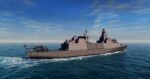
Canada’s Heavy Polar Icebreaker Program Gains Momentum with Seaspan-Genoa Partnership Expansion
-
| Defense Industry & Geopolitics Observer

Canada’s long-anticipated heavy polar icebreaker project has taken a significant step forward as Vancouver-based Seaspan Shipyards and Newfoundland’s Genoa Design International deepen their collaboration. The expanded partnership supports the design and engineering of the future flagship of Canada’s Arctic fleet under the National Shipbuilding Strategy (NSS), aimed at modernizing the Royal Canadian Navy and Canadian Coast Guard capabilities in extreme environments.
Strategic Importance of Canada’s Heavy Polar Icebreaker
The heavy polar icebreaker is a critical component of Canada’s maritime sovereignty strategy in the rapidly evolving Arctic region. With melting sea ice opening new shipping lanes and intensifying geopolitical competition in the High North, Ottawa has prioritized bolstering its presence through capable naval assets. The future vessel—intended to replace CCGS Louis S. St-Laurent—will be one of the most powerful non-nuclear icebreakers in the world upon completion.
The ship will support year-round operations in first-year and multi-year ice up to 2.5 meters thick and serve multiple missions including search-and-rescue (SAR), scientific research support, logistics for northern communities, environmental response, and sovereignty patrols. Its endurance is expected to exceed 270 days per year in service with a range exceeding 30,000 km.
Expanded Role for Genoa Design International
Under the updated agreement announced in May 2024, Genoa Design will significantly increase its role in delivering production design services for Seaspan’s heavy polar icebreaker program. This includes detailed 3D modeling using Siemens NX software within an integrated digital shipbuilding environment. Genoa has already supported earlier phases of design work on other NSS vessels such as the Joint Support Ships (JSS) and Offshore Oceanographic Science Vessel (OOSV).
The company will now embed over 100 personnel into Seaspan’s digital engineering ecosystem across Vancouver and Mount Pearl locations. The expanded scope includes structural modeling, systems integration layouts (HVAC, piping), outfitting design (accommodation modules), and configuration management aligned with Lloyd’s Register classification standards.
Seaspan’s Role Under Canada’s National Shipbuilding Strategy
Seaspan Shipyards was selected as one of two strategic partners under Canada’s NSS launched in 2010—alongside Irving Shipbuilding—which divides major ship construction between west coast (non-combat vessels) and east coast (combatants). Since then, Seaspan has delivered several key platforms including three Offshore Fisheries Science Vessels (OFSVs) and is currently building two JSS for the Royal Canadian Navy.
The heavy polar icebreaker represents one of the most complex ships ever built at Seaspan due to its size—over 150 meters long—and specialized hull form designed for continuous operation in multi-year Arctic pack ice. Construction is expected to begin later this decade following completion of full production design packages by mid-2025.
This project also supports over 1,300 jobs across Canada directly tied to NSS contracts through suppliers like Genoa Design, Thales Canada (combat systems integration), L3Harris Technologies (navigation systems), and others contributing subsystems or software solutions.
Technical Features & Capabilities of the Future Icebreaker
Although final specifications remain under refinement during pre-production engineering stages, publicly available data from Canadian Coast Guard requirements indicate that the vessel will feature:
- Ice Class: Polar Class 2 or equivalent; capable of sustained navigation through multi-year ice up to 2.5 m thick
- Powerplant: Likely diesel-electric propulsion system generating over 36 MW total power output
- Crew Complement: Approximately 100 personnel plus accommodations for scientists or mission-specific teams
- Aviation Facilities: Flight deck and hangar space for medium-lift helicopters such as CH-149 Cormorant or Bell 412
- Cargo Handling: Modular cargo bays with cranes capable of supporting resupply missions to remote Arctic stations
- Sensors & C4ISR: Integrated navigation radar suites optimized for high-latitude ops; potential inclusion of EO/IR surveillance turrets; secure SATCOM links via Iridium/GEO/MEO constellations
Toward Sovereign Arctic Presence Amid Rising Geopolitical Stakes
The expansion of this program comes amid growing international interest in Arctic access by NATO allies as well as near-peer competitors like Russia and China. Russia operates over 40 icebreakers—including several nuclear-powered—and continues militarizing its Northern Sea Route infrastructure. Meanwhile China declared itself a “near-Arctic state” in its official white paper on polar policy.
This context underscores why Canada is investing heavily not just in a single flagship but also across a broader fleet renewal effort that includes six new Medium Icebreakers announced under Budget 2023 alongside investments into satellite surveillance upgrades via RADARSAT Constellation Mission follow-ons.
A Digital-by-Default Approach to Naval Construction
A key differentiator for this program is its reliance on fully digital shipbuilding workflows from concept through production—a model pioneered by U.S.-based Huntington Ingalls Industries but increasingly adopted globally. The use of Siemens NX CAD/CAM tools allows real-time collaboration between naval architects at Genoa Design and manufacturing teams at Seaspan’s Vancouver drydock facility.
This digital twin approach reduces rework costs during assembly while enabling simulation-based validation prior to steel cutting—a critical advantage given harsh operating conditions expected north of latitude 60°N where repair options are limited mid-mission.
Timeline & Next Milestones Ahead
The heavy polar icebreaker remains on track per revised NSS schedules announced by Public Services and Procurement Canada (PSPC). Key upcoming milestones include:
- Mid-2025: Completion of full production-level design package by Genoa-Seaspan team
- Latter half of decade (~2027–2028): Commencement of steel cutting at Vancouver Shipyards following material procurement phase
- Early-to-mid 2030s: Delivery to Canadian Coast Guard after outfitting trials & acceptance testing phases complete (~2030–2031)
- Sundowning: Retirement phase-out plan for CCGS Louis S. St-Laurent, currently extended until ~2030 via MRO upgrades by Davie Shipyard
A Broader Industrial Footprint Across Canada’s Marine Sector
This project reinforces Canada’s commitment to maintaining sovereign shipbuilding capacity while distributing economic benefits nationwide—from Newfoundland’s digital designers at Genoa to British Columbia’s welders at Seaspan Yard West—and dozens more SMEs across Ontario, Quebec, Nova Scotia contributing parts or systems integration expertise.
Conclusion: A Flagship for Canada’s Northern Future
The expanded partnership between Seaspan Shipyards and Genoa Design marks more than just progress on a single vessel—it symbolizes Canada’s broader push toward asserting maritime sovereignty through advanced industrial capability matched with strategic foresight. As climate change accelerates transformations across global sea lanes, Ottawa appears determined not only to keep pace—but lead—in safeguarding national interests above the Arctic Circle.