AUSA 2025: Oshkosh Unveils Light Multi-Mission Autonomous Vehicle for Counter-UAS and Tactical Support
-
| Military Robotics & AI Analyst

At the Association of the United States Army (AUSA) Annual Meeting 2025 in Washington D.C., Oshkosh Defense unveiled its latest autonomous ground platform—the Light Multi-Mission Autonomous Vehicle (L-MMAV). Designed to support a range of tactical missions from counter-unmanned aerial systems (C-UAS) to logistics and reconnaissance, the L-MMAV represents a modular leap in robotic ground systems tailored to evolving battlefield needs.
Modular Design for Multi-Domain Operations
The L-MMAV is engineered as a scalable and mission-adaptable uncrewed ground vehicle (UGV) that can operate autonomously or via remote control. With an open architecture chassis based on Oshkosh’s proven mobility platforms, it supports multiple payload configurations including kinetic C-UAS weapons, electronic warfare modules, ISR sensors, or cargo transport kits.
Key design features include:
- Modular payload bays to enable rapid reconfiguration between roles such as surveillance, logistics resupply, or armed escort.
- Autonomy stack developed in partnership with Robotic Research LLC (now Applied Intuition), supporting obstacle avoidance, GPS-denied navigation, and convoy following.
- Hybrid-electric powertrain, offering silent watch capability and reduced thermal/acoustic signature.
The vehicle’s baseline weight is under 2 tons with payload capacity exceeding 1 ton depending on configuration. It is air-transportable by CH-47 Chinook or sling-loadable by UH-60 Black Hawk—critical for expeditionary forces operating in austere environments.
Counter-UAS Role Takes Center Stage
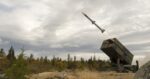
A key application showcased at AUSA was the L-MMAV’s integration with counter-unmanned aerial system technologies. Oshkosh demonstrated variants equipped with:
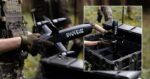
- Droneshield’s DroneSentry-X: a multi-sensor C-UAS module combining radar detection with RF jamming capabilities.
- Directed energy payloads: under evaluation are low-power lasers or microwave emitters for short-range drone neutralization.
This aligns with the U.S. Army’s ongoing efforts to proliferate mobile C-UAS platforms at echelon—from brigade combat teams down to platoon level—especially following lessons from Ukraine where loitering munitions pose persistent threats. The L-MMAV offers an agile platform to host such defensive systems while maintaining low visual and acoustic signature during operations.
Tactical Autonomy and AI Integration
The L-MMAV leverages advanced autonomy software developed under collaborative programs with the U.S. Army Combat Capabilities Development Command (DEVCOM). It supports supervised autonomy modes including:
- Leader-follower convoy mode
- Waypoint navigation in GPS-contested environments
- Obstacle detection via LiDAR/EO sensor fusion
The autonomy suite is compliant with Joint Architecture for Unmanned Systems (JAUS) standards and supports future upgrades towards full autonomous teaming under Optionally Manned systems doctrine. AI-based decision engines onboard allow basic threat classification—such as distinguishing drones from birds—and route optimization based on terrain analysis.
Logistics Support and ISR Applications
The modularity of the L-MMAV also makes it suitable for non-lethal roles such as:
- Tactical resupply missions: carrying ammunition or medical supplies across contested terrain without risking personnel.
- Sensors-on-the-edge ISR tasks: deploying EO/IR cameras or SIGINT payloads into forward positions to extend situational awareness beyond line-of-sight.
This dual-use capability aligns with US Army’s Robotic Combat Vehicle-Light (RCV-L) objectives and may offer an interim solution while larger RCV programs mature. Its small footprint also makes it attractive for special operations forces requiring stealthy mobility assets in denied areas.
AUSA Debut Signals Industry Readiness Amid Army Modernization Push
The unveiling comes amid renewed urgency within the Pentagon to field autonomous systems that reduce soldier exposure while increasing operational tempo. The L-MMAV complements other Oshkosh offerings such as the Joint Light Tactical Vehicle (JLTV) and integrates into broader Combined Arms Maneuver concepts under Multi-Domain Operations doctrine.
No formal procurement contract has been announced yet; however, sources indicate that limited user evaluations are expected through FY26 under Other Transaction Authority (OTA) agreements. The system may also be pitched toward export customers seeking low-cost robotic solutions for border security or urban defense scenarios against drone incursions.
Conclusion: Tactical Robotics Enter Next Phase of Deployment Readiness
The L-MMAV’s debut at AUSA underscores how rapidly unmanned ground platforms are maturing beyond experimental prototypes into mission-ready assets. By combining modularity, AI-enabled autonomy, and C-UAS relevance in one compact package, Oshkosh positions itself at the forefront of next-generation tactical robotics tailored to hybrid warfare realities seen in Eastern Europe and beyond.